Thanksgiving falls on Thursday, November 26, 2026, the fourth Thursday of the month, as a 1941 law requires. What the record holds about the 1621 gathering comes almost entirely from one short paragraph, written in December 1621 by an English colonist at Plymouth to a friend at home. The gathering it describes happened. A good deal of what grew up around it came later, and the documents let a reader tell the two apart.
Tennessee keeps a second autumn history. In October and November 1838, Cherokee detachments removed from their homeland were moving west through McMinnville, Woodbury, Winchester, Pulaski, and the roads toward Nashville. The letters written on those roads survive too.
Plymouth, 1621: one letter
Edward Winslow wrote his account in December 1621, and it was printed in London the next year in a pamphlet known today as Mourt’s Relation. Plimoth Patuxet Museums calls it the only eye-witness record of the celebration that survives. In the museum’s modernized spelling, it begins: “Our harvest being gotten in, our governor sent four men on fowling, that we might after a more special manner rejoice together, after we had gathered the fruits of our labors.”
He goes on: “At which time, amongst other recreations, we exercised our arms, many of the Indians coming amongst us, and among the rest their greatest king Massasoit, with some 90 men, whom for three days we entertained and feasted, and they went out and killed five deer, which they brought to the plantation and bestowed on our governor, and upon the captain and others.”
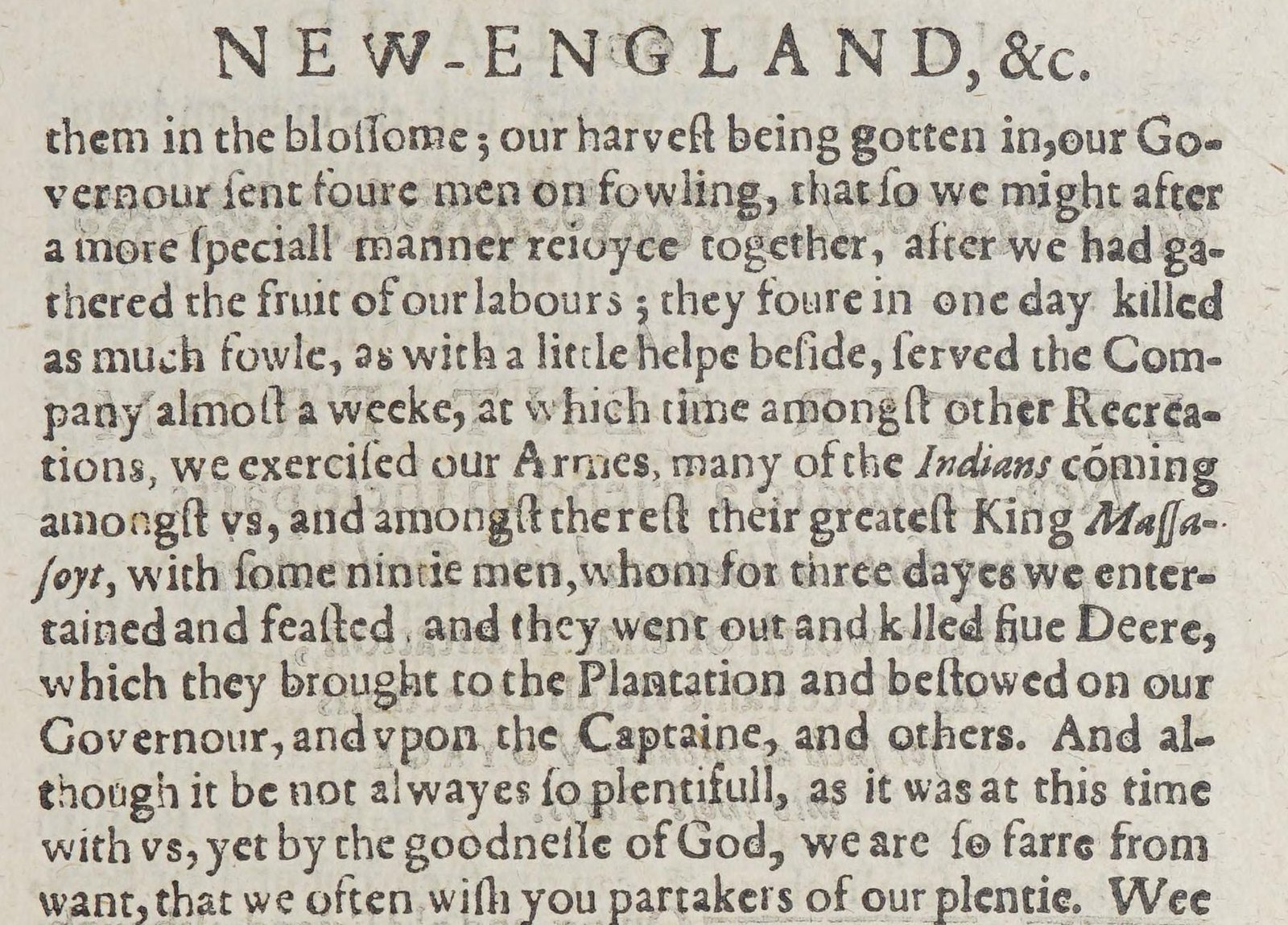
That is nearly all of it. The letter, dated December 11, gives no date for the gathering. For the feast it names only the fowl and the five deer. The word thanksgiving appears nowhere in it, though thanks does: Winslow credits the plenty to “the goodness of God,” and later asks his friend to “give God thanks who hath dealt so favorably with us.”
The colonists did keep days of thanksgiving, and they meant something specific by the phrase. Plimoth Patuxet’s historians describe them as religious days, called when circumstances warranted, usually on a weekday, and given over to church services and fasting. In 1623, when a summer drought broke, Plymouth set one apart. In the museum’s reading, a three-day harvest feast with guests and recreations belonged to a different custom, one both peoples already knew: harvest feasts were well established in both English and Wampanoag life.
The guests outnumbered the hosts. About half of the 102 Mayflower passengers were alive that fall: 24 men, five women, and 24 children and teenagers. Ousamequin, the Pokanoket sachem known to history as Massasoit, came with some 90 men. Indigenous women and children may also have been part of the group, the museum notes, and no Wampanoag record of the gathering survives.
Turkey is where the popular story most often outruns the evidence. Winslow does not mention it. William Bradford, the colony’s governor, wrote at least a decade later that as winter approached that year “there was a great store of wild turkeys, of which they took many, besides venison, etc.” He never described the gathering at all. Plimoth Patuxet’s own verdict is careful: “Although we can’t say for sure, it seems very likely.”
Why Massasoit came
Disease reached the coast before the Plymouth colonists did. Between 1616 and 1619, epidemics swept Native communities from present-day northern Maine to western Rhode Island, a time many local tribal communities today call the Great Dying. Patuxet, the village where Plymouth was built, was almost entirely depopulated. In March 1621 a visitor named Samoset told the colonists, as Mourt’s Relation records, that “about four years ago, all the Inhabitants died of an extraordinary plague, and there is neither man, woman, nor child remaining.” The English read the empty village as Divine Providence.
What the disease was remains unsettled. The classic explanations are yellow fever, smallpox, and plague; newer proposals include chickenpox and trichinosis. Writing in the CDC journal Emerging Infectious Diseases in 2010, the researchers J.S. Marr and J.T. Cathey added leptospirosis to the list. The toll is just as uncertain. Their review gives estimates from one third of the local population to as high as 90 percent, figures they note lack reliable data.
The epidemic also explains the alliance. On March 22, 1621, Ousamequin and Plymouth’s governor, John Carver, agreed to terms that included mutual defense: “If any did unjustly war against him, we would aid him; If any did war against us, he should aid us.” Each side had its reasons. The sickness had struck the Pokanoket and other Wampanoag communities hard while sparing their Narragansett neighbors, and Plimoth Patuxet’s historians write that the agreement “freed the Pokanoket from subjection to the Narragansett.” The English had lost half their number in their first winter. The written treaty itself does not survive.
Why Ousamequin brought 90 men to a harvest gathering is a matter of interpretation, and the record does not settle it. The museum suggests the feast may have served to reaffirm the alliance, which Wampanoag custom renewed through gifts and ceremony, and its historians call the five deer “essential to the diplomacy.” The Wampanoag and Penobscot historian Nancy Eldridge, as the museum quotes her, judged his attendance probably “a political show of force.” The two readings do not exclude each other. With a few exceptions, the alliance held for roughly half a century, until the war of 1675.
How a harvest became “the First Thanksgiving”
The name came two centuries later. In the 1830s, according to Plimoth Patuxet, New Englanders began calling the Pilgrims’ harvest feast the “First Thanksgiving,” because it looked so much like their own holiday of church services, family reunions, sports, and turkey. In 1841 the Unitarian minister Alexander Young reprinted Winslow’s letter in Chronicles of the Pilgrim Fathers with a footnote: “This was the first Thanksgiving, the harvest festival of New England.”
Plymouth’s claim to be first has competition. The 1619 instructions for Virginia’s Berkeley Hundred ordered that the day the settlers’ ship arrived be “yearly and perpetualy keept holy as a day of thanksgiuing to Almighty god,” in the document’s own spelling, and Encyclopedia Virginia notes that some twentieth-century Virginians claimed it as the first. The National Park Service notes a possible “First Thanksgiving” in 1541, between Francisco Vásquez de Coronado and the Teya Indians at Palo Duro Canyon in Texas.
The national holiday grew out of a long-standing New England harvest tradition, and one editor, Sarah Josepha Hale, campaigned for decades to carry it across the country. The Park Service dates her first essays for a national Thanksgiving to 1827, while Plimoth Patuxet dates the start of her campaign to the 1830s. In 1827 she also wrote what Plimoth Patuxet says is thought to be the first literary description of Thanksgiving, giving roasted turkey “precedence on this occasion, being placed at the head of the table.” As editor of Godey’s Lady’s Book from 1837 to 1877, she petitioned governors and presidents for years.
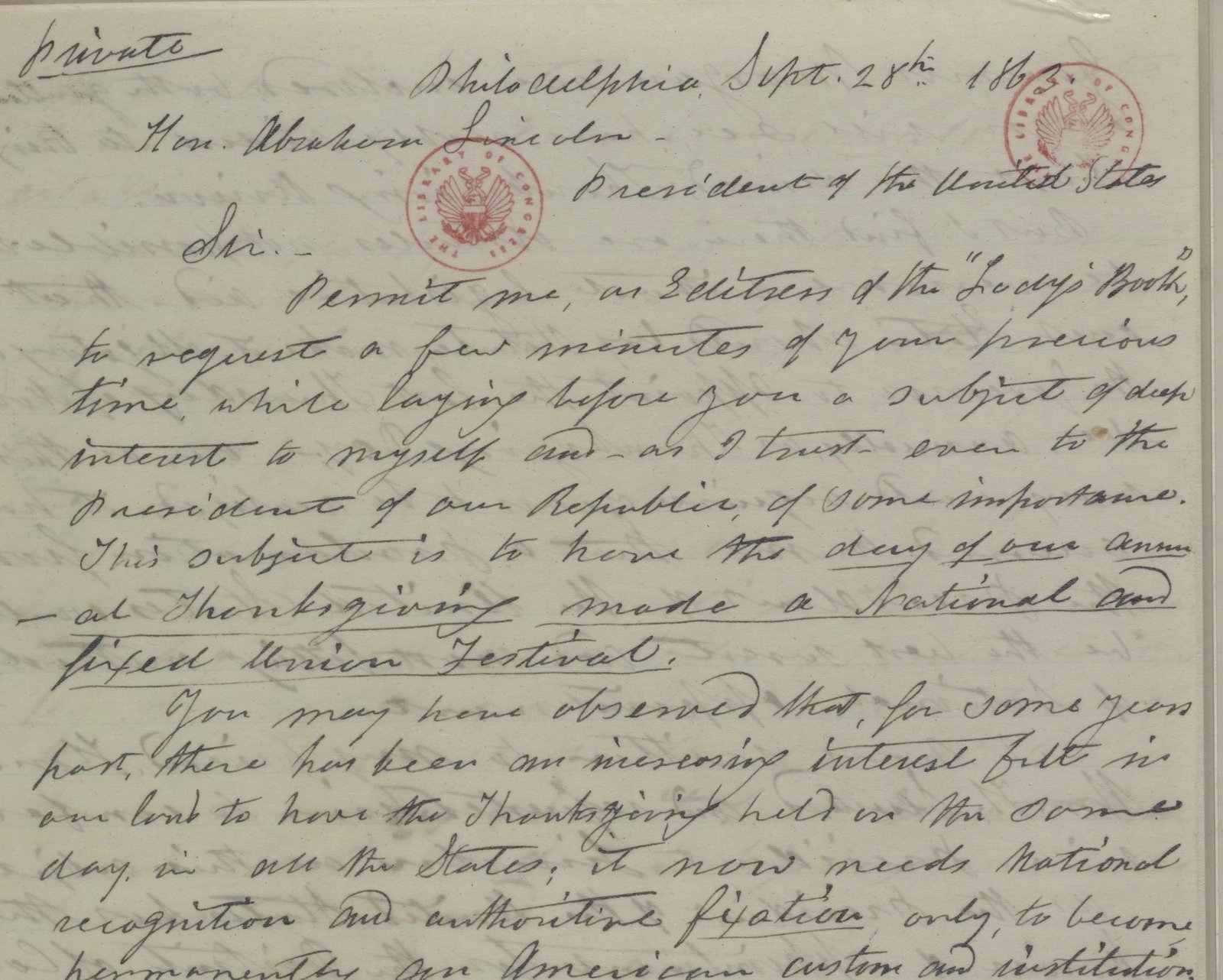
On September 28, 1863, Hale wrote to Abraham Lincoln. On October 3, three months after the Battle of Gettysburg, Lincoln issued a proclamation, penned by Secretary of State William Seward, inviting Americans “to set apart and observe the last Thursday of November next, as a day of Thanksgiving and Praise to our beneficent Father who dwelleth in the Heavens.” It asked them to implore the Almighty “to heal the wounds of the nation.” Earlier presidents had proclaimed days of thanksgiving, George Washington among them in 1789, but not every year. Who deserves the credit is a question the Park Service poses outright, naming Lincoln, Seward, and Hale. Lincoln receives it, the agency concludes, because the country has kept the holiday every year since 1863.

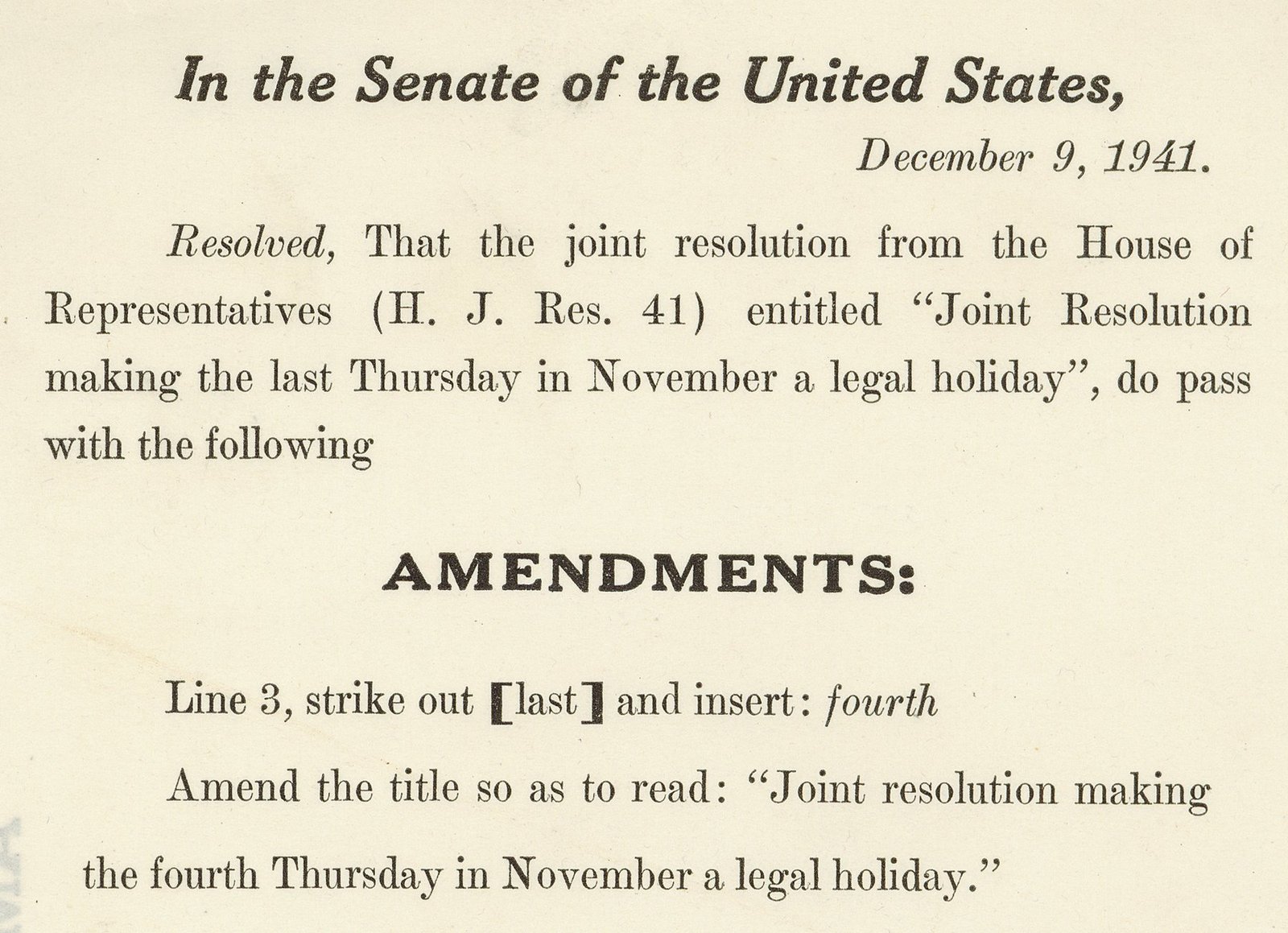
The date moved once more. In 1939, with the last Thursday falling on the last day of November, Franklin D. Roosevelt proclaimed the second-to-last Thursday instead, after business owners worried that a short Christmas shopping season could slow the economic recovery. Some states followed him, some refused, and some kept both days. Congress settled it. The House voted on October 6, 1941, for the last Thursday; the Senate changed that to the fourth Thursday, to account for years when November has five; and Roosevelt signed the joint resolution on December 26, 1941. It took effect in 1942.
Tennessee, 1838
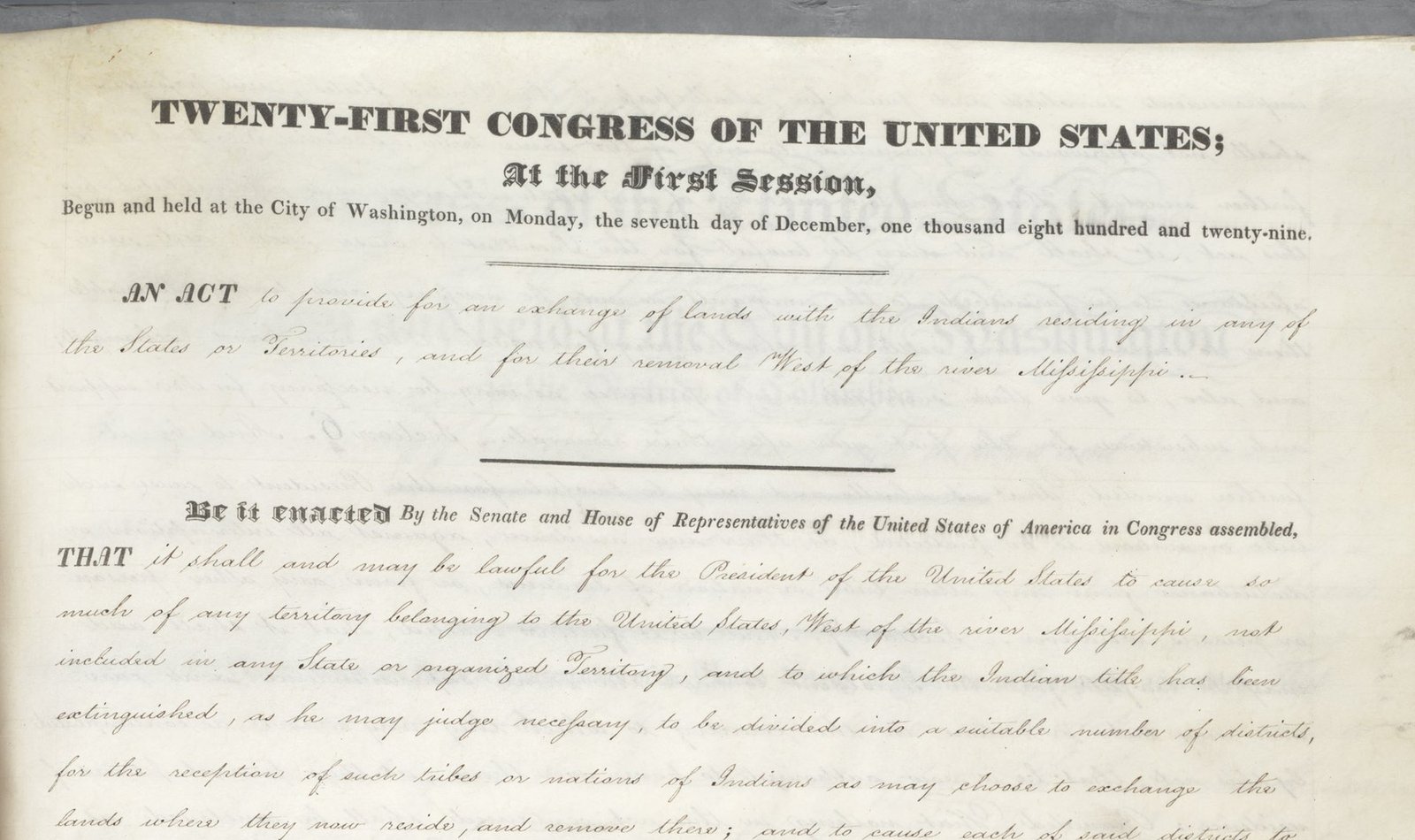
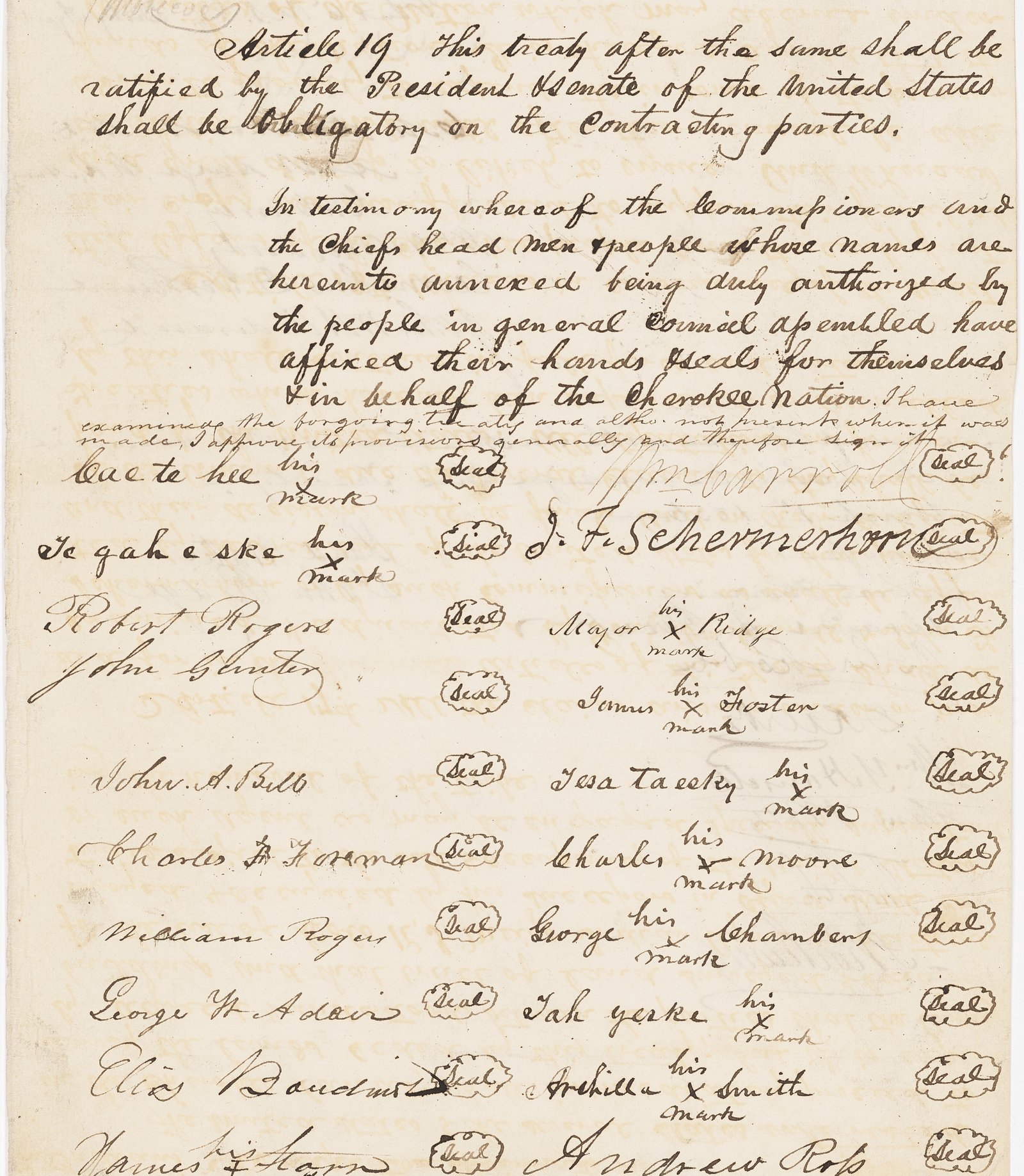
In late 1829, Andrew Jackson of Tennessee, the seventh president, told Congress it was time to move the American Indians living east of the Mississippi to the west. “This emigration should be voluntary,” his message said, “for it would be as cruel as unjust to compel the aborigines to abandon the graves of their fathers and seek a home in a distant land.” Those who stayed, it added, must be subject to state law. He signed the Indian Removal Act on May 28, 1830. The law authorized the president to grant lands west of the Mississippi in exchange for Indian lands inside existing states. A small faction of Cherokees signed the Treaty of New Echota on December 29, 1835, and the Senate ratified it in May 1836 by a single vote. Major Ridge, who led the signers, had argued for it: “There is but one path of safety, one road to future existence as a Nation.” Most Cherokees opposed the treaty. Jackson’s presidency ended in 1837, and in May 1838 his successor, Martin Van Buren, sent Gen. Winfield Scott to enforce it.
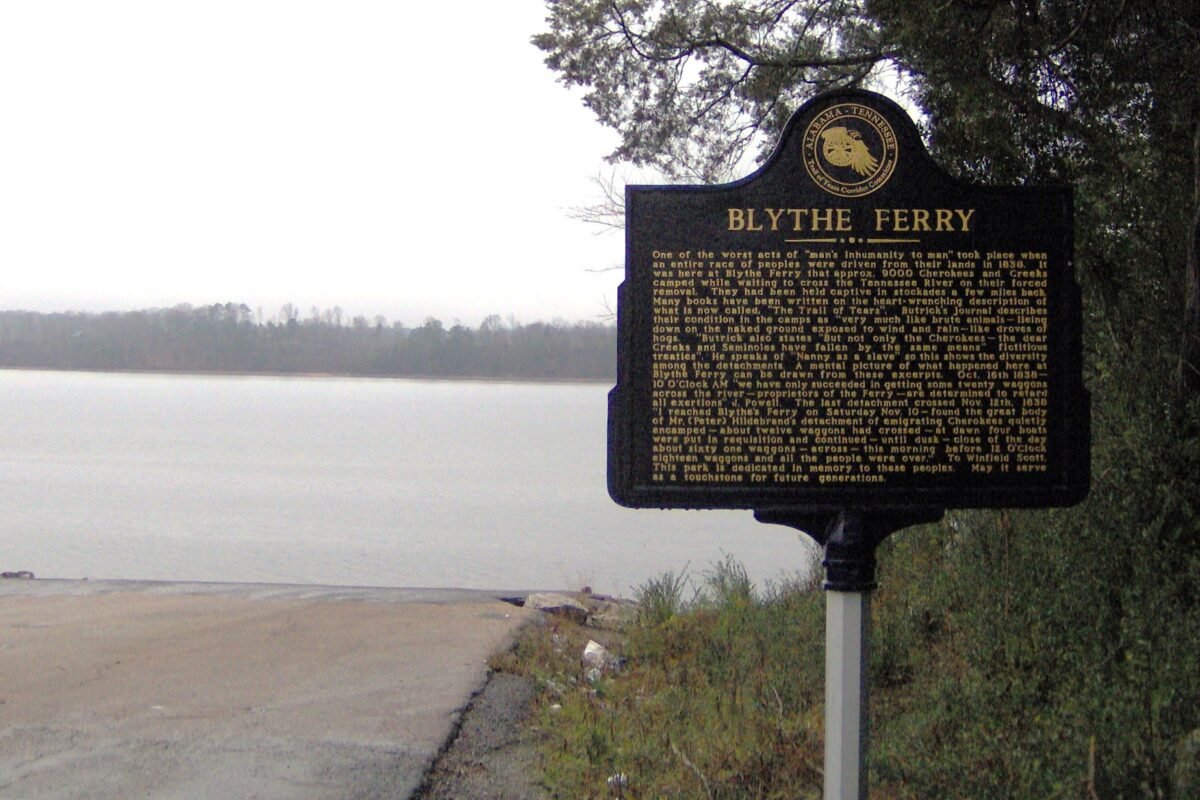
In May 1838, U.S. Army troops and state militia began forcing more than 16,000 Cherokee people from their homes in Tennessee, Alabama, North Carolina, and Georgia, by the Park Service’s count. Estimates differ: the Tennessee Encyclopedia puts the number who set out at about 14,000. About 7,000 people were held in camps across a 12-by-4-mile area around Fort Cass, at present-day Charleston, and many died of disease there before they ever set out. Three parties went west by water in June. A summer drought dried up the springs along the overland roads, and at the Cherokees’ request the rest of the removal was put off until fall, with the people held in the camps. By then Principal Chief John Ross had been put in charge of the removal. The people were organized into detachments of about 1,000 each. Most left from Fort Cass, crossed the Tennessee River at Blythe Ferry, and took the steep road over the Cumberland Mountains, averaging 10 to 12 miles a day. “The ground was frozen and the mountain steep,” the Rev. Daniel S. Butrick, who traveled with Richard Taylor’s detachment, wrote in November 1838.
On the roads of Middle Tennessee
Letters and journals from the road put some of the detachments in particular towns on particular days. On October 27, 1838, Evan Jones, traveling with the Situwakee detachment, wrote to John Ross from McMinnville that the party was “somewhat fatigued with passing so rapidly over the bad roads.” Tolls were another burden. “On the Cumberland Mountain they fleeced us,” Jones wrote. Then: “We will avoid several gates on the road to Nashville.”
Four detachments did leave the main road to avoid tolls, according to research by the Park Service and Middle Tennessee State University’s Center for Historic Preservation. They took the Old Jefferson Road around Murfreesboro toward Nashville. Butrick turns up in Woodbury on November 14, 1838, buying “new oil cloth” to cover the top of his carryall against the rain.
Farther south, other parties took other roads. Lt. Edward Deas of the U.S. Army administered the separate detachment, conducted by John Bell, of Cherokees who had signed the treaty. Near Winchester on October 27, Deas reported that “our progress has been necessarily slow, in consequence of the obstructions in the roads over which we have passed.” On November 12 he paid to ferry a party of about 600 to 700 Cherokees over the Tennessee River at Savannah. The Bell and Benge detachments both passed through Pulaski in October and November 1838. The detachment led by John Benge lost some children in the Pulaski area.
On the northern road, Port Royal, on the Red River, was the last stop in Tennessee. Diaries name it as a camp where the Cherokees stayed to resupply, grind corn, and rest, and Tennessee State Parks counts more than 10,000 Cherokees who passed through that fall and winter.
Winter at the river, and the count of the dead
In January 1839, two-thirds of the Cherokees were trapped between the ice-bound Ohio and Mississippi rivers. At Hamburg Hill in southern Illinois, eight detachments waited more than a month in freezing weather to cross into Missouri. The last detachment reached Indian Territory on March 24, 1839.
No one knows exactly how many died, and the estimates differ. The Park Service says more than a thousand died on the trip west, hundreds more deserted, and an unknown number, “perhaps several thousand,” died of the consequences. The Cherokee Nation counts nearly 4,000 lives lost, the Library of Congress gives about 4,000, and the Tennessee Encyclopedia more than 4,000. Elizur Butler, a missionary doctor who traveled with one detachment, estimated that nearly one fifth of the Cherokee population died.
The view from Cole’s Hill
Since 1970, Indigenous people and their allies have gathered at noon on Thanksgiving Day on Cole’s Hill, above Plymouth Rock, for a National Day of Mourning. It began when Wamsutta Frank James, an Aquinnah Wampanoag man, was asked to speak at a Commonwealth of Massachusetts banquet for the 350th anniversary of the Pilgrims’ landing, then told he would not be allowed to give his speech. “It is with a heavy heart that I look back upon what happened to my People,” that speech reads. The United American Indians of New England, which James helped found that year, has organized the day since. In 1998 the Town of Plymouth put a plaque on the hill on the group’s behalf.
The organizers describe the day in their own published words: “Thanksgiving Day is a reminder of the genocide of millions of Native people, the theft of Native lands and the erasure of Native cultures.” They also call it “a day of remembrance and spiritual connection, as well as a protest against the racism and oppression that Indigenous people continue to experience worldwide.” Many participants, the group says, fast from sundown the day before. The 2026 gathering is set for noon on Thursday, November 26. Plimoth Patuxet writes that for many Wampanoag people Thanksgiving is a day of mourning, and that Native people across the continent also keep their own traditions of giving thanks throughout the year.
The Cherokee today
Three federally recognized Cherokee tribes carry the story forward. The Cherokee Nation, based in Tahlequah, Oklahoma, calls itself the sovereign government of the Cherokee people, the largest of the three, and the largest tribal nation in the country, with a 14-county reservation.
The Eastern Band of Cherokee Indians is a sovereign nation in the Great Smoky Mountains of North Carolina, with more than 15,000 enrolled members, and its home is the Qualla Boundary. Tribal members living in Cherokee today, the tribe says, descend from Cherokees who held on to their land, hid in the mountains, or came back to western North Carolina.
The United Keetoowah Band counts more than 14,000 members and names Kituwah Mound, near present-day Bryson City, North Carolina, as its mother town. The band says it has called Tahlequah home since removal.
Gratitude and history at one table
Winslow closed his paragraph on abundance: “we are so far from want that we often wish you partakers of our plenty.” That fall, for one small colony and its guests, the plenty was real.
The journal’s reading is a modest one. Knowing what the documents show about Plymouth, and about the roads through McMinnville and Pulaski two centuries later, does not take the gratitude out of the day. It gives the gratitude something specific to hold: five deer carried in as a gift between allies, the families who walked west, the three Cherokee nations that carry on, and the people on Cole’s Hill, many of whom fast through that same afternoon. The national holiday itself began that way: Lincoln’s proclamation, issued in the middle of a war, asked for thanks and for the healing of “the wounds of the nation” in the same breath. Both histories can be told at the same table on Thanksgiving.
If you go
- Red Clay State Historic Park, Cleveland, Tennessee: on Wednesday, November 25, 2026, Cherokee Stories with Tito the Rabbit at 1 p.m. and a Cultural Connections Hike at 2:30 p.m. 423-478-0339.
- Cherokee Trail of Tears State Park, Birchwood, Tennessee: a Day after Thanksgiving Hike on Friday, November 27, 2026, noon to 1 p.m. Grounds open 6 a.m. to 5 p.m. from November through February. 423-339-2769.
- Port Royal State Historic Park, Adams, Tennessee: Follow Their Footsteps, a Day After Thanksgiving Hike, Friday, November 27, 2026, 10 to 11 a.m. 931-645-0622.
- Sequoyah Birthplace Museum, Vonore, Tennessee: closed Thanksgiving Day and closes early on Wednesday, November 25. 423-884-6246.
- New Echota State Historic Site, Calhoun, Georgia: closed Thanksgiving Day.
- Check before you go. Call a Tennessee state park before driving out on Thanksgiving Day itself, and confirm program times on each park’s page.
How we reported this
Built from primary documents and from National Park Service, National Archives, Library of Congress, Plimoth Patuxet Museums, Tennessee Encyclopedia, scholarly journal, state park, and tribal sources, checked in November 2026. If something has changed, write to editor@uppersouthjournal.com.
- Edward Winslow’s letter of December 1621, from Mourt’s Relation (1622)
- William Bradford, Of Plymouth Plantation: the harvest of 1621
- Mourt’s Relation: the Plymouth and Pokanoket alliance of 1621 and the arrival of Samoset
- Winslow’s full letter (University of Illinois transcription)
- Berkeley Hundred instructions, September 4, 1619 (Encyclopedia Virginia)
- Lincoln’s proclamation of October 3, 1863 (American Presidency Project), and the Park Service on it
- Jackson’s annual message of December 8, 1829 (American Presidency Project)
- National Archives: Thanksgiving as a Federal Holiday (the 1939 proclamation and H.J. Res. 41 of 1941)
- Library of Congress: Indian Removal Act, May 28, 1830
- National Archives DocsTeach: Treaty of New Echota, December 29, 1835
- Letters and journals of Evan Jones, Edward Deas, and Daniel S. Butrick, 1838, quoted by the National Park Service and the NPS and MTSU transportation booklet
- Wamsutta Frank James, the 1970 speech
- Plimoth Patuxet Museums: Unit 2, the alliance, Unit 4, the harvest celebration, A Day of Thanksgiving, 1623, Great store of wild turkeys?, Sarah Josepha Hale, Unit 5, and the National Day of Mourning plaque
- J.S. Marr and J.T. Cathey, Emerging Infectious Diseases, February 2010
- National Park Service, Trail of Tears National Historic Trail: history, FAQ, Hamburg Hill, Teaching with Historic Places lesson, Fort Smith National Historic Site, and the Tennessee Trail of Tears map and guide
- Tennessee Encyclopedia: Trail of Tears and Andrew Jackson
- United American Indians of New England: National Day of Mourning and background
- Cherokee Nation: About the Nation, Eastern Band of Cherokee Indians: culture, and United Keetoowah Band: About Us
- Tennessee State Parks: Red Clay, Cherokee Trail of Tears, and Port Royal; Sequoyah Birthplace Museum; Georgia State Parks: New Echota