Ten years ago, on the night of Monday, November 28, 2016, Gatlinburg emptied. More than 14,000 people left the city in the dark as wind drove fire out of the Great Smoky Mountains and into town. By the time the fires were out, 14 people had died and close to 200 had been hurt. The National Park Service’s own review puts the loss at 2,545 structures.
For the anniversary, the City of Gatlinburg and Sevier County Government set a public Gathering of Remembrance for 10 a.m. on Saturday, November 28, 2026, at Mynatt Park, where the city’s wildfire memorial now stands. The 1896 bell atop the Sevier County Courthouse is scheduled to toll at the same hour in memory of the 14.
Five days on the Chimney Tops
The fire was reported at about 5:30 p.m. on Wednesday, November 23, 2016, the evening the Thanksgiving holiday began. The park’s fire management officer spotted smoke near the Chimney Tops, the two rock peaks where a park trail ends, while out on a vehicle fire call that had been cancelled on the way. He hiked in with one other firefighter and found a creeping fire on the north peak in treacherous terrain. Judging that fighting it in the dark was unsafe, he hiked out and closed the trail.
The fall of 2016 had been dry across the Southeast. Park leaders planned to contain the fire inside a box of about 400 acres, using trails, creek bottoms, and other natural features as lines. According to the interagency team that later reviewed the response, crews did not start building those lines until Sunday, November 27, and in that drought the team judged the box’s chance of holding to be very low.
On Saturday, a weather outlook warned of high winds and rain for Monday. By Sunday, people in Gatlinburg and Pigeon Forge could see a distinct smoke column over the mountain. Helicopters began dropping water on its edge. On Monday morning, crews found a spot fire across Newfound Gap Road, about a mile from the peak.
Then the wind came, stronger than forecast. Sustained winds of 40 to 50 mph, with gusts to 87 mph, grounded the helicopters, carried embers ahead of the fire, and knocked down power lines in Gatlinburg. The Chimney Tops 2 Fire became the largest wildfire in the park’s history. It crossed the boundary at about 6 p.m. and merged with other fires, including new ones started by downed power lines. Together they became known as the Sevier County Fires. Inside the park, about 11,000 acres burned. Outside it, about 6,000 more did.
The night of November 28
Gatlinburg had no mass warning system in 2016. The city relied on police officers and firefighters knocking on doors. Around 8 p.m., officials sounded the downtown sirens, which had been installed for floods, and broadcast the evacuation on television and radio. People outside downtown did not hear the sirens.
At about 8:30 p.m., wind and flames took out cell towers, melted fiber-optic cables, and cut phone lines and digital radio. Downed power lines shut down Gatlinburg’s emergency operations center and its internet phone system, which had no backup. Sevier County’s emergency management director had been trying to reach the Tennessee Emergency Management Agency about sending an evacuation text. The state drafted one, recommending Highway 321 as a way out and naming shelters, then lost contact with the county. Because the county had to approve the wording, the message never went out. The only state text alert that reached anyone, sent hours after the fire began, asked people to stay off their phones.
Most of the people who died were on the western side of town, just outside the city limits, the Knoxville News Sentinel reported. The count used by the Park Service, the city, and the county is the same: 14 lives.
What the reviews found
Two formal reviews followed. The first, by an interagency team of seven fire experts ordered by the Park Service, covered only the five days the fire burned inside the park. Interior Secretary Ryan Zinke released it on August 31, 2017. The team concluded that “a lack of wildland fire preparedness during a period of drought conditions favorable to wildfires overwhelmed National Park Service response.” It also found that the decisions made by the people fighting the fire were in line with their knowledge and experience of fire in the region.
The park had not ordered the staff its own plan called for at that level of fire danger. The fire management officer was serving as duty officer and incident commander at the same time, which the review said was contrary to Park Service policy. No Red Flag Warning was issued during the fire. Park radios could not talk to the fire departments next door. Cell coverage in the park was thin or missing. The team recorded one sentence it heard from responders again and again: “I’ve never seen anything like this, and I never even imagined this could happen.” It called the new conditions the park’s “new normal.”
The second review, prepared by ABS Consulting for about $100,000, looked at how Gatlinburg and Sevier County agencies responded once the fire left the park. As the News Sentinel reported in December 2017, it found that “insufficient warning by (the park) contributed to a dramatically reduced time frame to conduct needed evacuations.” It recommended early warning systems and ways to reach tourists who do not know the area.
A federal study published in 2020, drawing on almost 400 survey responses from Sevier County residents, found that only 22.7 percent had received any warning. Nearly 80 percent of those who evacuated left on the day the fire reached the city. “Instead many had to find out on their own,” said Emily Walpole, a NIST social scientist and one of the authors.
The charges and the lawsuits
The Park Service review describes the fire as human-caused. The park, ATF, and the Tennessee Bureau of Investigation investigated. In December 2016, two teenagers were arrested and charged in state court. The Park Service gives the charge as aggravated arson.
On Friday, June 30, 2017, District Attorney General Jimmy Dunn dropped those charges. As WPLN reported, Dunn said the high winds and the separate fires started by downed power lines made it “impossible to prove which fire may have caused the death of an individual or damage to a particular structure,” and that “the state has no other option but to dismiss the charges pending in state court.” The charges were dismissed before any trial. Dunn also said the fire started inside the park, and a 1997 agreement between Tennessee and the Interior Department places crimes there under federal jurisdiction. When the state charges were dropped, WUOT reported, no federal charges had been announced.
Individuals and insurance companies also took the federal government to court, seeking damages for deaths and property destroyed by the fire. On March 31, 2026, U.S. District Judge J. Ronnie Greer dismissed 11 consolidated cases, finding that park officials had carried out the assessments and issued the warnings their fire plan required. Greer wrote that the park’s decisions on when and how to warn the public were “far from perfect” but were protected by the discretionary function exception, WVLT reported.
Rebuilding
The city stayed closed to visitors for close to two weeks. When it reopened, one problem was what people had heard. “The word was out that Gatlinburg had burned to the ground, and that certainly was not the case,” Cindy Cameron Ogle, the city’s former longtime city manager, told WBIR in November 2026. Ripley’s Aquarium of the Smokies could not move its roughly 11,000 animals when the city was evacuated. The building survived. So did every animal.
By August 2017, about $922 million in losses had been filed with insurers, not counting uninsured property, according to the Tennessee Department of Commerce and Insurance, and more than $45 million had come in federal and state assistance, including $12.45 million in Small Business Administration loans. “This is our home,” Gatlinburg Mayor Mike Werner said that summer. “People need to know everything is going to be OK and we’re going to bounce back.”
Within days of the fire, Dolly Parton’s Dollywood Company and the Dollywood Foundation set up the My People Fund, which promised $1,000 a month to Sevier County families who had lost their homes. A telethon, Smoky Mountains Rise, aired on December 13, 2016. By December 23, the fund had raised $9.3 million. By March 2017, the fund was paying 921 families, once a month for six months. Parton died in Nashville in August 2026, at 80. Her Associated Press obituary recalled the telethon and the monthly checks.
What changed
The warnings came first. Gatlinburg spent $215,201 on a new siren system with five sirens, switched on May 19, 2017, to replace the flood sirens the fire damaged. A second phase, budgeted at about $500,000, was to add four sirens covering Ski Mountain, Chalet Village, North Chalet Village, and the Spur. The county’s CodeRED phone and text alerts were opened up so Gatlinburg, Pigeon Forge, and Sevierville could send their own. The state also approved Gatlinburg’s application to send alerts directly to every phone in an area through the federal emergency alert system. In 2016, the city had to ask the state to send them. One thing did not change. Emergency planners told Sevier County Mayor Larry Waters that the terrain of Gatlinburg and Sevier County does not allow formal evacuation routes, the News Sentinel reported in 2017.
In the park, the first priority was radios. Key parts of the system dated from 2003, the manufacturer no longer supported it, and rangers could not talk directly to the departments outside the boundary. Park leaders named a new system their top priority after the fire, at a cost of about $2.5 million, with $1 million from the federal government and the rest from the nonprofit Friends of the Smokies. “The lifeline for our emergency responders is their radios,” park spokeswoman Dana Soehn told WFAE in 2017. The Park Service also said it would provide portable radios and protective gear to seven neighboring fire departments.
The park also uses prescribed fire to reduce the dead wood and brush that feed big fires in a drought. Crews now burn half of Cades Cove each year, on a two-year cycle that replaced a three-year one. Burns along the boundary near Wears Valley have cleared fuel where beetle-killed pines stand beside neighboring communities. Outside the park, a county-wide committee on fire-adapted communities formed after 2016. By 2022, Sevier County had 10 recognized Firewise USA communities. In January 2024, Sevier County, Sevierville, Gatlinburg, Pigeon Forge, the state’s forestry division, and the park began work on a joint community wildfire protection plan.
The risk has not gone away. In March 2022, a fire pushed by strong winds and dry ground on Hatcher Mountain in Wears Valley burned about 2,500 acres and damaged 213 structures, a federal mitigation team reported later that year.
The mountain itself
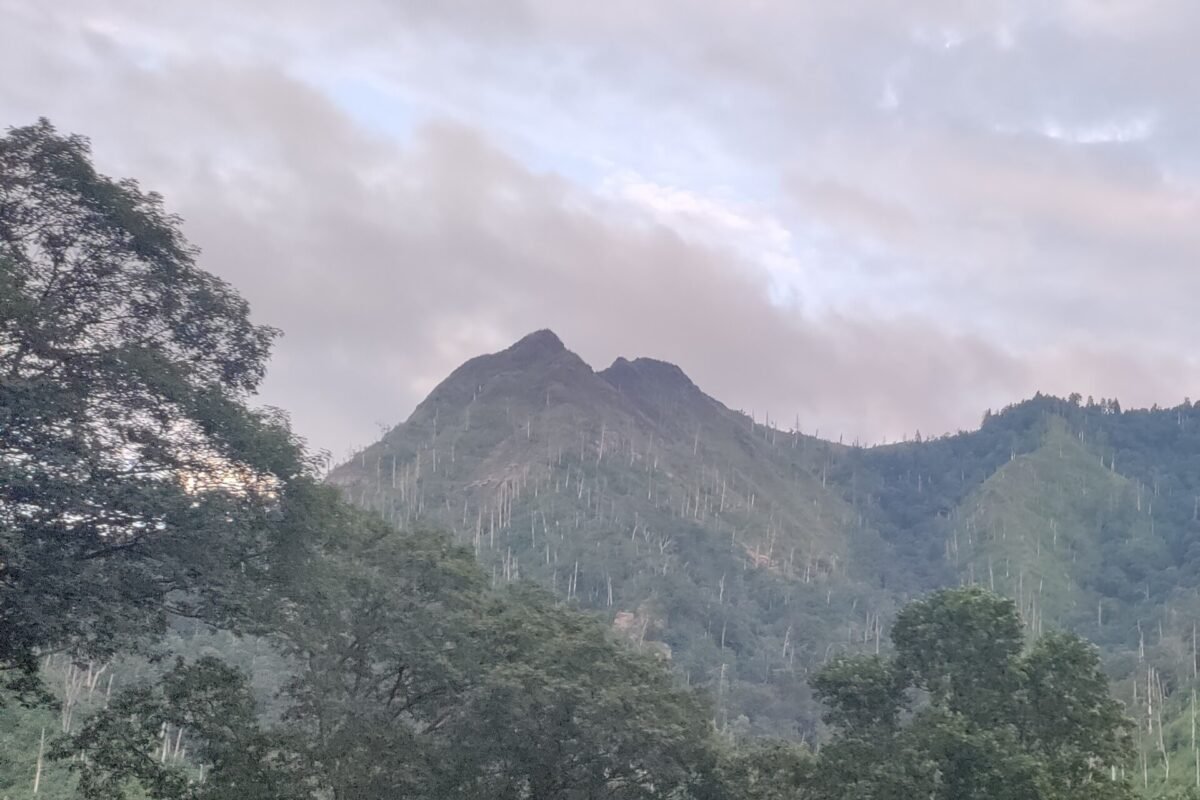
The fire and wind stripped trees and soil from the top of the Chimney Tops and left bare rock. The park closed the last quarter mile of the Chimney Tops Trail and built an observation deck where hikers can look at the peaks from a distance. The summit section is still closed, behind a gate at the end of the trail. Park staff photograph the same slopes from the same spots over time, and between 2017 and 2025 those photographs show fire cherry and birch filling in the burned ground. The park uses them to judge when the summit might be stable enough to reopen.
Marking ten years
The memorial at Mynatt Park was dedicated by the city and the county in June 2023. It is two plazas, one on each side of LeConte Creek. One remembers the people who died. The other honors the agencies that came to help during the fire and the recovery.
The anniversary gathering is planned to honor the 14 and to recognize the responders, volunteers, and organizations that helped in the response and the recovery. Randy Brackins, Gatlinburg’s police chief in 2016, recalled for WVLT this month that police and fire officials met with park officials, who told them they could not locate the front of the fire because of the smoke.
If you go
- Anniversary gathering: 10 a.m. Saturday, November 28, 2026, at Mynatt Park. Parking at the park is limited. Free city shuttles leave from Gatlinburg Fire Department Station No. 2, 309 Reagan Drive, starting at 9:15 a.m., with rides back after the ceremony.
- Chimney Tops Trail: open to the observation deck; the final quarter mile to the summit is closed. Check the park’s trail conditions before hiking.
Frequently asked questions
How many people died in the 2016 Gatlinburg fires?
Fourteen people died, and close to 200 were injured.
Where is the Gatlinburg wildfire memorial?
At Mynatt Park in Gatlinburg, on both sides of LeConte Creek. The city and Sevier County dedicated it in June 2023.
Can you hike to the top of the Chimney Tops?
No. Since the fire, the park has closed the last quarter mile of the trail. An observation deck below the summit looks out at the peaks.
How we reported this
Built from the National Park Service’s review and park pages, city and county records, federal research, and news coverage from 2016 to 2026, checked in November 2026. If something has changed, write to editor@uppersouthjournal.com.
- National Park Service: Chimney Tops 2 Fire review, 2017 (PDF)
- National Park Service, August 31, 2017: NPS releases review of Chimney Tops 2 Fire
- Great Smoky Mountains National Park: Chimney Tops 2 Fire, Wildland Fire, and Chimney Tops 2 Fire repeat photography
- Friends of the Smokies, July 27, 2026: Chimney Tops hike recap
- City of Gatlinburg: 2016 Wildfires Memorial and Tribute Plaza
- Tennessee Town & City, June 12, 2023: Gatlinburg dedicates wildfire memorial
- Smokies Live, November 8, 2026: Gatlinburg, Sevier County to mark 10th anniversary of Chimney Tops 2 wildfires and Gatlinburg Now: 10-year remembrance gathering
- USDA Forest Service Community Mitigation Assistance Team: Sevier County report, May 2022 (PDF)
- NIST, September 2, 2020: Insights into behavior during Chimney Tops 2 Fire could improve evacuation planning
- Knoxville News Sentinel via GovTech, August 2017: Gatlinburg wildfire records tell story of chaos, confusion and Gatlinburg expands emergency notification system
- Knoxville News Sentinel via FireRescue1, December 2017: Report says poor communication cost time, lives in Gatlinburg wildfire
- Associated Press via WMOT, December 14, 2016: cell towers down, no fire evacuation text alert
- WPLN, June 30, 2017: State drops charges against two juveniles in Gatlinburg wildfire and WUOT, June 30, 2017: Prosecutors drop wildfire charges
- Associated Press via Insurance Journal, August 9, 2017: Tennessee mountain community getting back on its feet
- Associated Press via CBS Boston, December 1, 2016: Dolly Parton pledges $1,000 a month to wildfire families, MusicRow, December 23, 2016: My People Fund climbs to $9.3 million, and Global News, March 15, 2017: fund pays 921 families
- WVLT via WSMV, April 1, 2026: Federal judge dismisses Gatlinburg wildfire lawsuits against US government
- Associated Press via WTOP, August 26, 2026: Dolly Parton has died at 80
- WBIR via Yahoo News, November 2026: Ripley’s Aquarium reflects on the 2016 Gatlinburg wildfires
- WVLT via Daily Dispatch, November 2026: Former Gatlinburg first responders reflect on 2016 wildfire response
- WFAE, November 28, 2017: Great Smokies park turns to private partner to fund radio upgrade
- WATE via Yahoo News, April 25, 2025: Sevier County partners with cities, Smokies national park on wildfire protection plan