At a Glance
Start: Natchez Trace Parkway northern terminus, milepost 444, near Nashville
End: Colbert Ferry, milepost 327.3, in northwest Alabama, with a side trip to Florence and Muscle Shoals
Total Distance: About 117 Parkway miles from the terminus to Colbert Ferry
Speed Limit: 50 mph unless posted; commercial vehicles are prohibited
Recommended Duration: One full day, or two with the music stops
Open Now: The Double Arch Bridge at milepost 438 is closed, with the Park Service’s timetable running through May 2027, and a 7.5-mile detour
Best Season: Late autumn and winter for long views from Freedom Hills; mid-March to mid-April for dogwoods
In 1785, boatmen from Kentucky floated their goods down the Mississippi to Natchez and New Orleans. A flatboat cannot go back upstream, so they sold the boats for lumber and started north on foot, or on a borrowed horse, along a footpath that American Indians had used for trade and travel for centuries. The Park Service calls them Kaintucks. The path they walked was already old, and the Park Service dates human use of the corridor back 10,000 years.
Congress made the Natchez Trace a park unit in 1938, and the parkway was finished in 2005. It is the only national parkway built to commemorate an ancient travel route. The full road is 444 miles from Natchez, Mississippi, to a terminus outside Nashville. This route takes the northern end of it, counting the mileposts down from 444 at Nashville to 327.3 at the Tennessee River in Alabama.
Two rules shape the day. The speed limit is 50 mph unless a sign says otherwise, and commercial vehicles are prohibited. Without trucks, the road keeps the pace of the people it was built for. Fill the tank in Nashville. By design, the Parkway has no commercial services, so gas and food are found in towns off the exits.
Milepost 444 to 438: the bridge that is closed
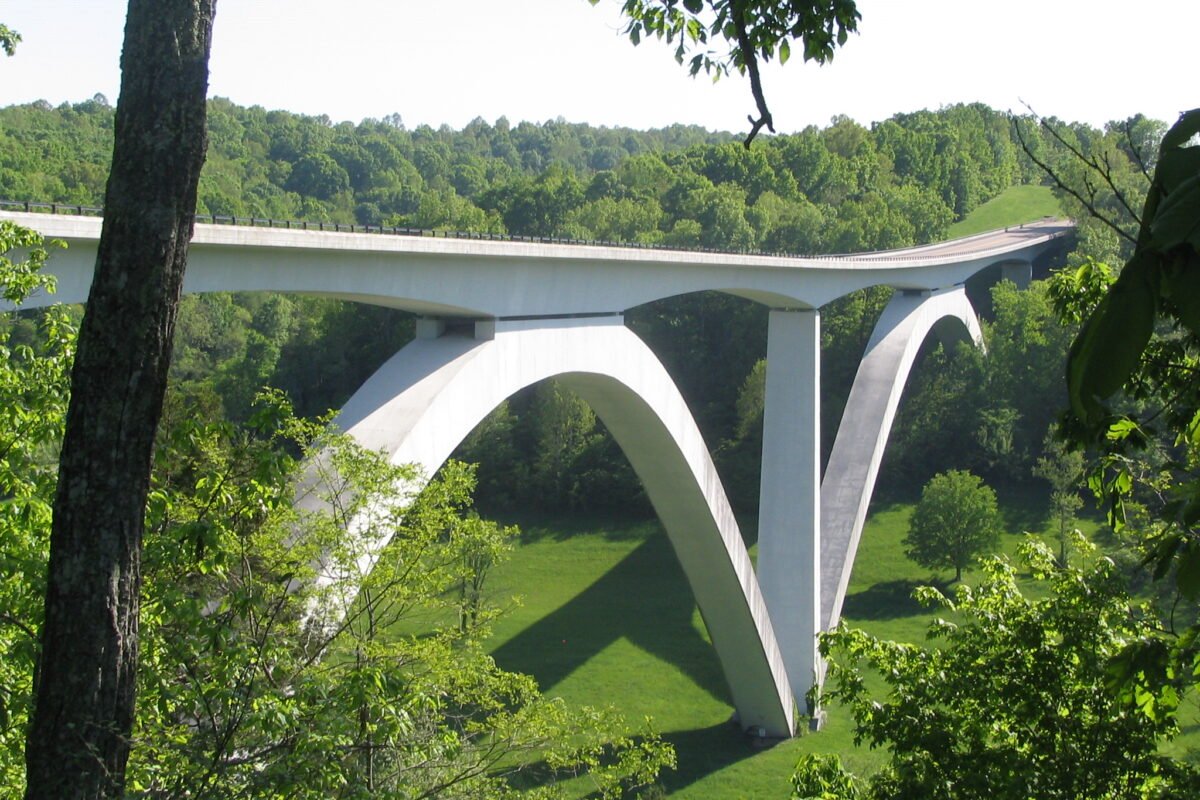
Start with the bad news. The Double Arch Bridge at Birdsong Hollow, milepost 438, is closed to cars, pedestrians, and cyclists. The Park Service announced on April 10, 2026, that the closure would begin April 15 and last until spring 2027, while crews replace a temporary barrier with a permanent pedestrian safety barrier and repaint the bridge. Its road status page, updated November 3, 2026, still lists the section as closed, with a timeframe of April 2026 to May 2027. The Parkway is shut between Big Tree Overlook at milepost 440 and the Highway 96 off-ramp at milepost 437, with a detour of 7.5 miles posted by way of Highways 100 and 96. From the northern terminus, cars can still drive to Big Tree Overlook and back. A drive south meets the detour almost at once, so look at the Parkway’s road status page before leaving home.
The bridge deserves the mention even closed. It spans Birdsong Hollow for 1,572 feet, opened in 1994, and carries the road about 155 feet above the valley. It is the Parkway’s showpiece, and in spring 2027 it should be possible to stop at the overlook again.
Milepost 427 to 401: a low-slung country of stone and water
South of the closure, history comes in small doses. At milepost 426.3 a memorial honors volunteers who marched the Trace in the War of 1812, including those in unmarked graves. A mile north, Garrison Creek is named for a U.S. Army post that stood nearby in 1801 and 1802.
Gordon House, at milepost 407.7, is the stop for people who want to see what the Trace looked like when it was still a working road. It is a two-story brick house, and the Park Service counts it as one of only two structures from the Old Trace era left standing on the Parkway. Three miles on, Jackson Falls drops into a clear pool at the end of a 900-foot paved path with boardwalks. The path is steep, with stairs. At milepost 401.4, a barn built in 1959 from timber grown on the farm shows the tradition of hanging tobacco in season.
Milepost 385.9: Meriwether Lewis
The most important stop in Tennessee is a quiet one. Meriwether Lewis, governor of the Upper Louisiana Territory, left St. Louis on September 4, 1809, to protest the War Department’s refusal to pay vouchers he had submitted. He reached Grinder’s Stand on the evening of October 10. Mrs. Grinder heard two gunshots in the night and found him wounded. He was dead by sunrise on October 11. The Park Service says historical accounts support the probability of suicide.
He was buried a few hundred yards from the stand. In 1848 the Tennessee legislature voted $500 to preserve the grave, and the monument that followed is a broken shaft, the emblem of a life cut short by an untimely death. A cemetery of local settlers, begun in 1856 and holding roughly 100 burials, is beside it. The cabin at the site was built in 1935. It is not a reconstruction of Grinder’s Stand, and no drawing of the original exists.
The paved Footsteps Through History Trail leads to a short unpaved section of the Old Trace. A campground of 32 first-come sites has water and flush toilets, no electricity, and no fee. Plan to linger. This is the place where the history of the Trace and the history of the Corps of Discovery meet.
Two shorter stops fall on either side. At milepost 391.9, Fall Hollow drops about 20 feet, and the trail to it is rough and steep. At milepost 382.2, Metal Ford marks a crossing of the Buffalo River named for its stone bottom.
Milepost 370: a road with a harder history
The Trace served trade first, and later it figured in removal. At milepost 370, where Highway 64 crosses the Parkway, a covered exhibit shelter carries panels about the Trail of Tears and the route John Bell led. It deserves five minutes more than most overlooks.
The Alabama miles
Alabama holds 33 miles of the Parkway, with the same 50 mph limit. The state’s tourism office names six stops. Three repay a detour.
Freedom Hills Overlook, at milepost 317.0, is the highest point on the Parkway in Alabama. A steep trail climbs about a quarter mile to the view, with a few benches along the way. Late autumn and winter give the longest sight lines once the leaves are down. Dogwoods bloom here from mid-March to mid-April.
Rock Spring, at milepost 330.2, is a natural spring with deep pools that hold small fish, and stepping stones cross Colbert Creek. Hummingbirds visit in spring and fall.
Colbert Ferry, at milepost 327.3, is the end of this route and its best story. George Colbert, the son of a Scottish father and a Chickasaw mother, held a treaty right from 1800 to 1819 to operate a ferry across the Tennessee River here, and he kept an inn and a plantation besides. Exhibits and parking mark the spot. A short walk climbs to the ridge where his home stood, and a walk of about 20 more minutes on the Old Trace reaches a bluff over the river.
A side trip to the Shoals
Past the river, northwest Alabama has a second reason to take the Trace. The towns of Florence, Muscle Shoals, and Sheffield produced a body of recorded music out of proportion to their size. A good detour has three stops.
FAME Recording Studios, at 603 East Avalon Avenue in Muscle Shoals, began in 1959 above City Drug in downtown Florence, when Rick Hall, Billy Sherrill, and Tom Stafford opened it. The partnership ended a year later. Hall kept the name and moved into a former candy and tobacco warehouse. Arthur Alexander’s “You Better Move On” reached No. 24 on the Billboard Hot 100. Wilson Pickett cut several hits at FAME, and Aretha Franklin’s session was cut short after a dispute and finished in New York. The studio’s own list of artists includes Little Richard, Etta James, Otis Redding, Candi Staton, and Clarence Carter. Tours of Studios A and B last about an hour and cost $20, with a $40 backstage tour that adds Hall’s office and instruments from historic sessions. They leave at 9 a.m. and 4 p.m. on weekdays, and at 10 a.m., noon, and 2 p.m. on Saturday.
In 1969 the Swampers, FAME’s house rhythm section, left to open Muscle Shoals Sound Studio at 3614 North Jackson Highway in Sheffield. The Rolling Stones recorded three songs there in December 1969, and Lynyrd Skynyrd, Bob Seger, Willie Nelson, and Linda Ronstadt all worked with the studio in the 1970s. The studio is now owned by a nonprofit, the Muscle Shoals Music Foundation, and gives 45-minute tours Tuesday through Saturday from 10 a.m. to 4 p.m. No advance ticket is required.
The third stop is older. W. C. Handy, called the Father of the Blues, was born in Florence in 1873. His birthplace cabin was taken apart, its logs numbered, and rebuilt at 620 West College Street, where it opened as a museum on June 7, 1970. It displays the upright piano on which he composed “St. Louis Blues” and his trumpet. In 1954, when a city housing project threatened the cabin, Handy gave the city the $29,000 he had received for the land so that it could be restored. The museum marks his birthday every November 16 with music and free admission. This year the party is from 11 a.m. to 1 p.m. on Monday, November 16.
Mind the calendar. FAME closes its tours over Thanksgiving weekend and again between Christmas and New Year, and says its holiday schedule varies from year to year.
Plan your trip
- Closures: the Double Arch Bridge and the Parkway between mileposts 440 and 437 are closed, with a Park Service timeframe through May 2027. Check the Parkway’s road status page before you leave.
- Rules: 50 mph unless posted. Commercial vehicles are prohibited.
- Services: fill the tank in Nashville. The Parkway has no commercial services; gas and food are off the exits.
- Camping: Meriwether Lewis Campground has 32 free, first-come sites. Stays are limited to 14 consecutive nights.
- Winter: the Park Service says winter days are mild, around 50 degrees, but lows below freezing are not uncommon. Check the forecast for ice before a cold morning start.
- Shoals tours: FAME posts its tour times on its tour page, Muscle Shoals Sound gives tours Tuesday through Saturday, and the Florence-Lauderdale visitor center at 200 Jim Spain Drive, (256) 740-4141, can confirm both.
Frequently asked questions
What is the speed limit on the Natchez Trace Parkway?
The posted limit is 50 mph unless a sign says otherwise. Commercial vehicles are prohibited, which keeps trucks off the road.
Is the Double Arch Bridge open?
No. The Park Service closed the bridge to all users on April 15, 2026, for a permanent pedestrian barrier and painting. Its road status page, updated November 3, 2026, gives a timeframe of April 2026 to May 2027. The Parkway is shut between mileposts 440 and 437, with a 7.5-mile detour.
Where is the Meriwether Lewis site on the Natchez Trace?
At milepost 385.9 in Tennessee. It has Lewis’s monument and grave, the Grinder’s Stand site, a pioneer cemetery, a paved trail, and a free campground.
How long is the Natchez Trace Parkway in Alabama?
About 33 miles, with the same 50 mph limit. Stops include Freedom Hills Overlook at milepost 317.0, Colbert Ferry at 327.3, and Rock Spring at 330.2.
Can you tour FAME Studios in Muscle Shoals?
Yes. Standard tours cost $20 and last about an hour. Backstage tours cost $40. FAME closes tours over Thanksgiving weekend and the Christmas and New Year holidays, so confirm before you go.
How we reported this
This route was built from National Park Service pages, the Alabama tourism office, the Encyclopedia of Alabama, and the studios’ own sites, all checked in November 2026. Confirm current road status before you drive.
- National Park Service, Natchez Trace Parkway: Frequently Asked Questions
- National Park Service, Natchez Trace Parkway: History and Culture
- National Park Service, Milepost 341.7 to 444
- National Park Service, Double Arch Bridge to close for construction
- National Park Service, Exploring the Meriwether Lewis Site
- National Park Service, Natchez Trace Parkway: Current Conditions
- National Park Service, Natchez Trace Parkway: Road and Site Status
- National Park Service, Natchez Trace Parkway: Eating and Sleeping
- National Park Service, Freedom Hills Overlook
- National Park Service, Colbert Ferry Stand Site
- Alabama Tourism Department, Cruising the Natchez Trace Parkway
- Encyclopedia of Alabama, FAME Studios
- FAME Recording Studios and its tour page
- Muscle Shoals Sound Studio
- Encyclopedia of Alabama, Muscle Shoals Sound Studio
- Encyclopedia of Alabama, W. C. Handy Birthplace, Museum, and Library
- Alabama Tourism Department, W.C. Handy Birthday Celebration
- Florence-Lauderdale Tourism