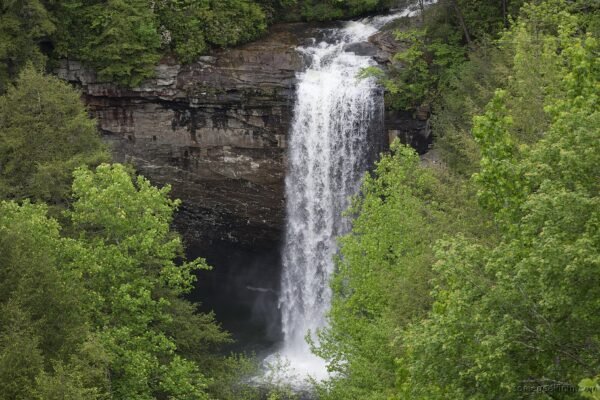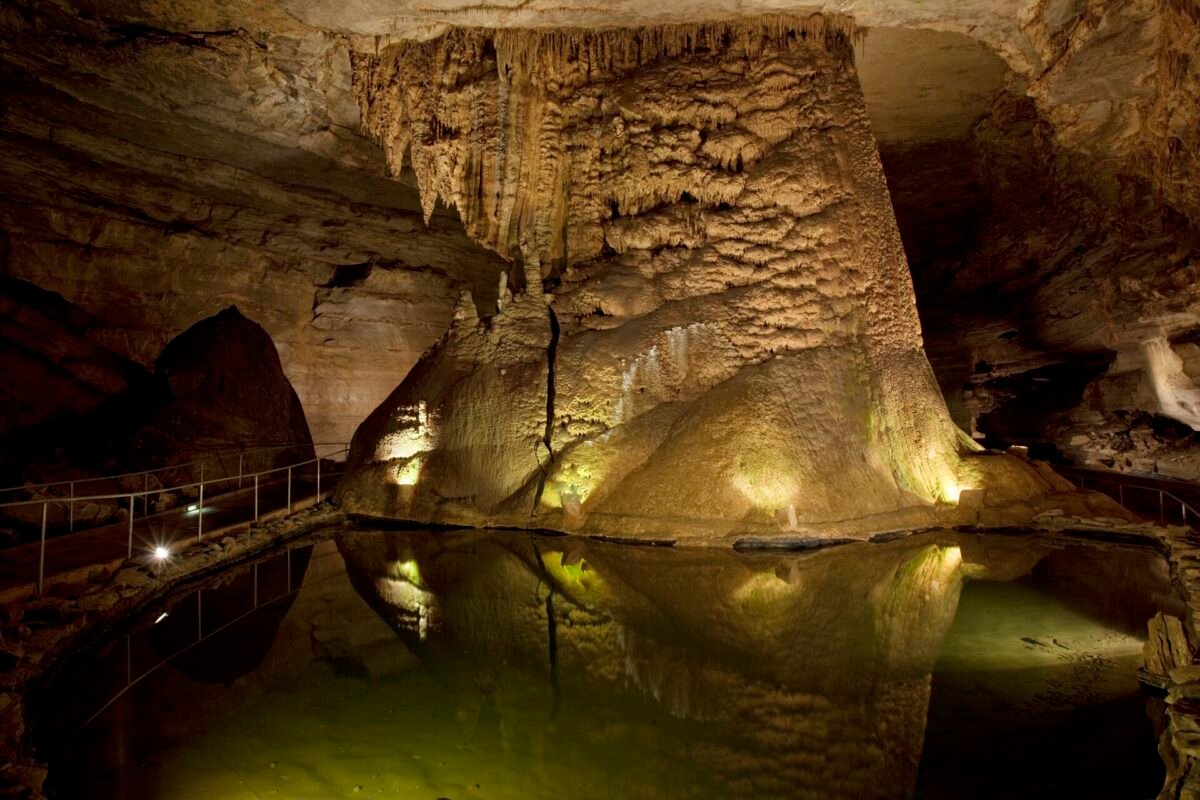
Tennessee has more than 9,500 reported caves. Of the more than 50,000 reported across the United States, nearly one in five is in Tennessee, according to a 2013 survey in the journal PLoS One. The densest cluster follows the western edge of the Cumberland Plateau, and north Alabama shares the same limestone. Only a handful of those caves have a ticket booth. Most of the rest are private, gated, or closed by law.
Why the Upper South is full of caves
Caves of this kind start as rain. Water picks up carbon dioxide from the air and from soil, and the result is a weak carbonic acid. It seeps down until it reaches limestone, then follows cracks and fractures and dissolves the rock a little at a time. Once the cracks are wide enough for water to flow through, the work speeds up. Streams enlarge the passages, and sediment scours the walls. Later, dissolved minerals come out of the dripping water and build stalactites, stalagmites, and flowstone.
Geologists call the whole landscape karst: limestone country where sinkholes, sinking streams, and caves are normal features. The Highland Rim, the Cumberland Escarpment, and the Tennessee Valley all qualify.
A cave’s temperature has an equally simple explanation. The National Park Service says the temperature of the bedrock controls the temperature of the air in a cave, and bedrock is often close to the average surface temperature for the year. Seasonal swings at the surface do not reach the rock at the depth of most caves. The caves below bear it out. Ruby Falls and Cathedral Caverns hold at 60 degrees, and the Lost Sea and Raccoon Mountain Caverns hold at 58.
Ruby Falls, Chattanooga
Ruby Falls is on Lookout Mountain, and its story is one of patience. Leo Lambert spent about a decade working out how to reach a cave that had been sealed off, then raised $250,000 from investors for the Lookout Mountain Cave Company. Excavation began in 1928. At about 260 feet down, the crew broke into a void. Lambert and a small group explored it, and the waterfall they found took the name of his wife, Ruby.
Visitors now take a glass-front elevator 260 feet into the mountain. The cave walk is a one-mile round trip with 36 stairs and some uneven pathways, and the tour typically takes an hour and 20 minutes. The destination is a waterfall the site calls the tallest cave waterfall open to the public in the United States. Tickets are timed and the slots sell out, so buy online in advance. The address is 1720 S. Scenic Highway. Ruby Falls marks Discovery Day each December 30.
Raccoon Mountain Caverns, Chattanooga
Raccoon Mountain Caverns offers two kinds of visit. The Crystal Palace Walking Tour is guided and takes 45 to 55 minutes through the first quarter mile of the cave, with lights, pathways, steps, and handrails. The Wild Cave Expeditions go deeper, and guests crawl, climb, slide, and squeeze. The cave holds more than 5.5 miles of passageways at a constant 58 degrees.
The Lost Sea, Sweetwater
The Lost Sea is in Craighead Caverns, about seven miles from Exit 60 on I-75. The tour is a guided three-quarter-mile round trip of about an hour and 15 minutes. It ends with a boat ride on an underground lake, 140 feet below the surface, in electric-motor boats. The lake is about 58 degrees.
The Lost Sea tells its history in layers. The Cherokee knew the cave, and artifacts turned up in the Council Room, nearly a mile from the entrance. Tracks of a giant Pleistocene jaguar, about 20,000 years old, were found deep inside. Settlers around 1820 stored vegetables in the constant cool. The Confederate Army mined it for saltpeter, and graffiti dated 1863, carbon-tested as authentic, is the oldest known date in the cave. The lake itself waited until 1905, when 13-year-old Ben Sands squeezed through a muddy opening about 300 feet underground and found a room half filled with water.
The cave bills the lake as listed by the Guinness Book of World Records as America’s largest underground lake. The visible water is 800 feet long and 220 feet wide, about four and a half acres. Divers have mapped more than 13 acres of flooded rooms beyond it, with no end found. The cave closes only on Thanksgiving and Christmas Day.
Cumberland Caverns, McMinnville
Cumberland Caverns bills itself as the longest show cave in Tennessee, with at least 27 miles surveyed. Aaron Higgenbotham found the cave on Cardwell Mountain in 1810. In 1838, Cherokees used his turnpike during the Trail of Tears. Surveyors connected Henshaw Cave and Higgenbotham Cave in 1953, and the combined system took the Cumberland Caverns name. Roy Davis opened it to the public on July 4, 1956. It was designated a National Natural Landmark in 1973, and it has hosted the Bluegrass Underground concert series since 2008.
Of everywhere on this list, it has the widest range of visits. The walking tours include Cardwell Mountain History, Discovery, and Lanterns and Legends. The adventure tours carry names like Hall Crawl and The Crucible. The address is 1437 Cumberland Caverns Road, and the cave is open year-round, seven days a week.
Tuckaleechee Caverns, Townsend
Tuckaleechee Caverns is the one to pair with a drive into the Smokies. It first opened to the public in 1931 and closed after a year, a casualty of the Depression. Two college students, Bill Vananda and Harry Myers, reopened it in 1953 after about four years of hauling sand, cement, and gravel into the cave by hand. A National Speleological Society group led by Burt H. Denton Jr. of Nashville, working with the Tennessee Geological Cave Survey, found the Big Room in 1954. It measures more than 400 feet long, 300 feet wide, and 150 feet deep, with stalagmites up to 24 feet tall. The room opened to the public in 1955, and electric lights replaced kerosene lanterns.
The newest public section is Silver Falls, a 210-foot double waterfall. Only the lower falls can be seen in full, and the upper falls are visible from a lighted room. The tour is a 1.25-mile round trip, and the posted schedule covers March through November.
Cathedral Caverns State Park, Woodville, Alabama
Of all the caves here, Cathedral Caverns is the one with a public-land story. It was called Bat Cave until Jacob Gurley opened it to the public in the 1950s and renamed it for its cathedral-like proportions. The state of Alabama bought it in 1987, and it opened as a state park in the summer of 2000. The park describes an entrance 126 feet wide and 25 feet high, a world record for commercial caves. Inside, Goliath is a stalagmite 45 feet tall with a 243-foot circumference, and a flowstone wall known as the frozen waterfall stands nearby. The cave holds at 60 degrees.
The park covers 493 acres and recommends reserving tours in advance. Pets are not allowed in the cave. Its address is 637 Cave Road in Woodville.
Russell Cave, a monument you cannot enter
Russell Cave National Monument near Bridgeport, Alabama, is the opposite case. The National Park Service puts it flatly: you cannot go in the cave. What the monument preserves is one of the most complete records of prehistoric life in the Southeast. Archeologists first excavated in 1953, and later digs recovered more than two tons of artifacts from four cultural periods. The earliest inhabitants are believed to date to about 12,000 to 11,000 years ago. Paleo-Indian and Archaic peoples lived at the site for years at a time, and other groups used it as winter shelter.
The monument is at 3729 County Road 98.
Why wild caves are closed
Most of the caves in the region are not show caves, and most of those are off limits to the public. The reason is a fungus. White-nose syndrome was first found in New York in the winter of 2006, and some bat colonies have lost up to 99 percent of their bats. The National Park Service says the disease has affected seven bat species, including the endangered Indiana and gray bats, and posted a U.S. Fish and Wildlife Service estimate that more than 5.7 million cave-dwelling bats have died of it. Scientists believe the disease depletes the fat reserves bats need to survive hibernation.
Tennessee moved early. On July 6, 2009, the state announced that caves on land managed by the Tennessee Wildlife Resources Agency, the Department of Environment and Conservation, and the Division of Forestry would close for a year. The closure covered state parks, forests, and wildlife management areas, and WPLN reported a new $500 fine for entering a cave on agency property. Biologists feared that cavers who failed to disinfect their gear could carry the fungus from one cave to the next. The state extended the closure in 2011 and said it did not affect privately owned caves, commercial caves included. Ask the agency or the park whether the closure still stands before entering any cave on state land.
Federal land follows its own rules. Great Smoky Mountains National Park prohibits entry into caves and mine shafts. The U.S. Forest Service signed a decision on June 2, 2014 to close caves and mines across its Southern Region, including the Cherokee National Forest, to limit the spread of the disease. The project page gives no end date, so for any cave on Cherokee National Forest land, ask the forest supervisor’s office at (423) 476-9700 whether the closure still applies.
Alabama is the cautionary tale. White-nose syndrome was confirmed on April 8, 2013, at Fern Cave National Wildlife Refuge in Jackson County. Fern Cave holds the largest documented wintering colony of endangered gray bats, more than a million. The refuge entrances are closed, and the entrance on land managed by the Southeastern Cave Conservancy requires a permit. The Fish and Wildlife Service advice for anyone who wants to cave is short: check with the land manager before visiting any cave, and decontaminate clothing, footwear, and gear. Northern long-eared bats, once common in Alabama, are now very rare, according to the state’s outdoors agency.
The theory behind the closures is that people can carry the fungus on footwear, clothing, and gear, and the state noted in 2011 that infected caves may not show obvious signs of it. The commercial caves above are private operations, and the Tennessee closures did not cover them.
Plan your trip
- Book ahead: Ruby Falls sells timed tickets online and the slots fill. Cathedral Caverns recommends reserving tours. The Lost Sea advises buying tickets in advance too.
- Dress for 58 to 60 degrees: that is the temperature at Ruby Falls, the Lost Sea, Raccoon Mountain Caverns, and Cathedral Caverns. Wear shoes with grip, since cave floors are wet and uneven.
- Wild tours need a different body: Raccoon Mountain’s Wild Cave Expeditions and Cumberland Caverns’ adventure tours involve crawling and squeezing. Read the tour description before booking.
- Seasons: the Lost Sea closes only on Thanksgiving and Christmas Day. Cumberland Caverns lists seven days a week. Tuckaleechee’s posted schedule covers March through November, so confirm before driving to Townsend in winter.
- Pets: not allowed inside Cathedral Caverns. Confirm each cave’s policy before bringing a dog.
- Do not enter any other cave. In the Smokies it is prohibited, and elsewhere a closure or a fine may apply. Ask the land manager first, and decontaminate gear.
- Hours and prices change. Check each cave’s own site before you go.
Frequently asked questions
Can you visit Russell Cave in Alabama?
You can visit the monument, but you cannot go in the cave. The National Park Service says so directly. The site preserves artifacts from about 12,000 years of human use.
What is the longest show cave in Tennessee?
Cumberland Caverns, near McMinnville, calls itself the longest show cave in Tennessee. Its 1978 survey reported at least 27 miles of cave.
How cold is it inside a cave?
Constant. Ruby Falls and Cathedral Caverns hold at 60 degrees, and the Lost Sea and Raccoon Mountain Caverns hold at 58. The National Park Service explains that bedrock temperature sets cave air temperature, and bedrock tends to match the average surface temperature.
Can you explore wild caves in the Smokies?
No. Entry into caves and mine shafts in Great Smoky Mountains National Park is prohibited because of white-nose syndrome.
What is white-nose syndrome?
A fungal disease of hibernating bats, first found in New York in the winter of 2006. Some colonies have lost up to 99 percent of their bats.
How we reported this
The reporting drew on official park and cave websites, National Park Service and U.S. Fish and Wildlife Service pages, and published state and academic sources. Hours, prices, and closures change, so confirm with each site before you go.
- Ruby Falls: our story and cave walk
- Raccoon Mountain Caverns
- The Lost Sea: history and facts
- Cumberland Caverns: about
- Tuckaleechee Caverns: development of the caverns
- Alabama State Parks: Cathedral Caverns
- National Park Service: Russell Cave National Monument and its history
- National Park Service: solution caves, making a cave, and cave geology
- National Park Service: white-nose syndrome and Great Smoky Mountains caves
- Niemiller and Zigler, PLoS One study of Tennessee caves, May 22, 2013
- State of Tennessee, public caves closed, July 6, 2009 and closure extended, May 27, 2011
- WPLN, White-nose syndrome closes Tennessee caves, July 6, 2009
- U.S. Forest Service, Southern Region Caves and Mine Closures
- U.S. Fish and Wildlife Service, White-nose syndrome confirmed at Fern Cave, April 8, 2013
- Outdoor Alabama, Gates at Weaver Cave protect habitat at risk for bats, October 21, 2021