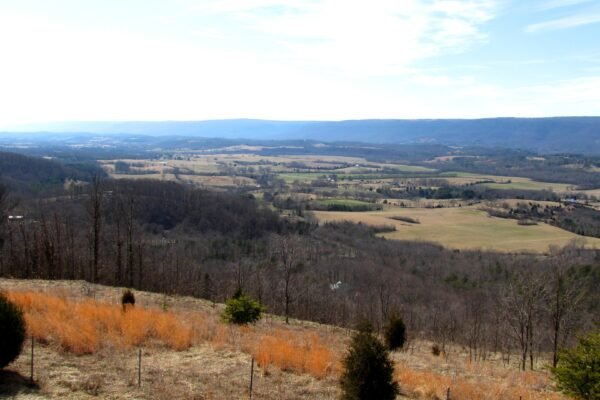
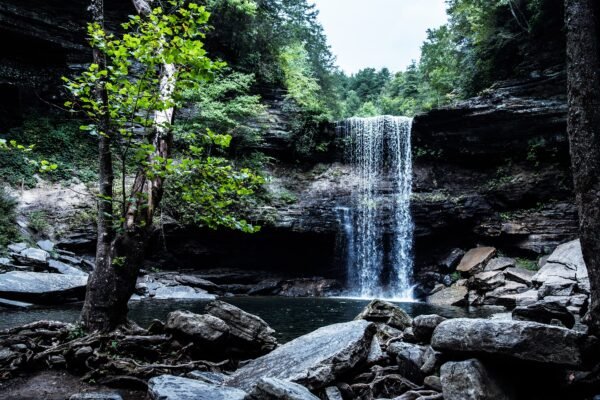
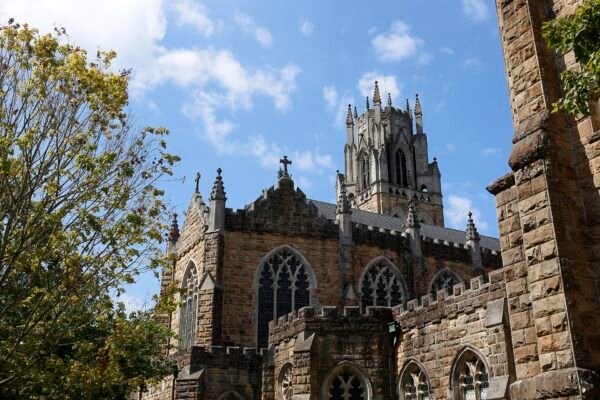
Coal got to the Cumberland Plateau long before anybody dug it. The Grundy County Heritage Center in Tracy City opens its first gallery with the geology: how the plateau’s coal formed in the Pennsylvanian period. Everything else in the building follows from that one fact. Towns, a railroad, an ironworks, a prison camp, and a revolt all trace back to a seam of coal.
The story is easy to tell as a story of industry. It is better told as a story of labor, because on the South Cumberland Plateau the two cannot be pulled apart. Some of the men who dug the coal were free miners who struck for their wages. A great many were not free at all.
A company from New York comes up the mountain
The Sewanee Mining Company was formed in 1852 to develop coal on the plateau. Its president was Samuel F. Tracy, a New York financier. The company needed a way to get coal off the mountain, so it built a railroad from the Nashville and Chattanooga main line at Cowan up to Sewanee. The line is known as the Mountain Goat.
Mining began in 1856 at a place called Coal Bank. The coal there was scarce and poor. The company pushed the tracks another ten miles to the Wooten Mine, and the first load of coal from Wooten went down the mountain on November 8, 1858. The Wooten site became the town of Tracy City. By 1860 the company had exhausted its money and filed to reorganize as the Tennessee Coal and Railroad Company.
War interrupted the work. Confederates took over the mine first, and Federal forces secured the plateau and the mine in July 1863. In 1866, Arthur St. Clair Colyar arranged a settlement: $400,000 in common stock was issued, bought by Colyar, and used to pay off the company’s Tennessee creditors.
Coal was only the start. Coke, coal baked in ovens until the impurities burn off, was the fuel that ironmaking needed. A makeshift blast furnace, nicknamed Fiery Gizzard, went up to test whether the mine’s coal would coke. It turned out fifteen tons of pig iron before it fell apart. That was enough to show that coke from the plateau’s Sewanee Seam could make pig iron in a blast furnace. The name outlived the furnace and now belongs to the Fiery Gizzard Trail. Around 1872, Tracy City produced the first iron made solely with Tennessee coke, according to a history of plateau coal mining by James B. Jones Jr. of the Tennessee Historical Commission, published by the National Park Service.
Ovens followed. The Heritage Center says 120 coke ovens went up at the Wooten Mine site in 1873. The Tennessee Encyclopedia describes Grundy Lakes as part of a complex of 130 coke ovens established and operated by the Tennessee Coal, Iron, and Railroad Company in 1883. Counts and dates differ from source to source. Either way, this was coke made on an industrial scale, on top of a mountain.
Prisoners in stripes
Mining on that scale needed a workforce, and the company found one in the state penitentiary. Tennessee leased its prisoners to private firms from 1866 to 1896. The system was meant to make prisons pay for themselves and to raise money toward the state’s debt. Convict miners were first brought to Tracy City and Sewanee in 1871, according to a chronology in a 1974 oral-history collection in Southern Exposure. The company that leased them was the same one that held the coal.
The arrangement widened over time. In 1884, the Tennessee Coal, Iron, and Railroad Company leased the state penitentiary for an annual fee of $101,000. After 1889 it could sublease prisoners to other companies. The Tennessee Encyclopedia reports that the company employed 60 percent of the state’s prison population as miners. The 1974 collection puts the number of men it leased from the state at about 1,600.
One of its stockades stood at Lone Rock, just outside Tracy City, on land that is now part of Tennessee’s state park system. Camille Westmont, a postdoctoral fellow in historical archaeology at the University of the South in Sewanee, led an excavation there. Her team’s research describes the place in detail. The stockade held about 100 inmates in the early 1870s and more than 500 by the 1890s. Upward of 95 percent of the prisoners at Lone Rock were Black, ranging in age from 14 to 70. Women were held there too, and were forced to do domestic work for the stockade and for people nearby. Across the state’s prison system, less than 5 percent of inmates were Black in 1860. By 1866 the figure was 52 percent. By 1896 it was as high as 75 percent.
The work was set by quota. Each prisoner was issued one striped uniform and a daily amount of coal to mine without pay. Prisoners worked six days a week, and a quota could be as much as two tons. Those who missed it were publicly whipped. A wooden fence two stories tall enclosed a yard slightly larger than a football field, with barracks, a hospital, a commissary, a kitchen, a dining hall, and a guard house inside. Even the bath houses were segregated. By the Sewanee account, about 10 percent of the prisoners died every year, from tuberculosis, typhoid fever, intestinal illness, mining accidents, and guards shooting prisoners. Westmont’s team transcribed more than 1,500 prison records of inmates sent to Lone Rock.
The same company had helped found the university whose archaeologists later dug at its stockade. The Sewanee Mining Company donated 5,000 acres to the Episcopal Church to help start the University of the South.
The miners push back
Free miners saw what leased convicts did to their own wages. In January 1871, white miners at Tracy City struck the company for higher pay and an end to convict labor. The Tennessee Encyclopedia calls it the first revolt against the lease system. Jones’s Park Service history adds that the strikers made a nighttime armed assault on the prison compound, intending to set the convicts free. The company won.
The fight came back in 1891. On July 14 of that year, three hundred miners at Briceville, in Anderson County, surrounded a stockade, took charge of its forty prisoners, and shipped them in boxcars to Knoxville. It was the start of what became known as the Coal Creek War. In August 1892, miners in Grundy County revolted at two company sites, Inman and Tracy City. Those attacks set off new revolts in Anderson County.
The 1974 collection preserves the Tracy City side in miners’ own recollections. Tracy City miners had been cut to half-time in July 1892 while convicts worked full time. In August, a committee of miners took the stockade keys at gunpoint and put the convicts on a train to Nashville. I. H. Cannon, who had started in the No. 1 mine at Tracy City at 16, estimated that about 300 men took part. The stockade burned that month, and Cannon remembered the convicts themselves setting the fire. The convicts came back and stayed about two years, in a stockade built with gun openings and guard houses on top of each corner. In April 1893, between 50 and 100 men made an unsuccessful attack on it.
The lease system did not outlast the decade. In 1893 the legislature passed a law to build a new penitentiary and to end leasing when the contract expired in 1896.
After the company leaves
The corporate map of the plateau redrew itself in the early twentieth century. In 1904 the Tennessee Coal, Iron, and Railroad Company moved its offices from Tracy City to Ensley, near Birmingham, Alabama. Three years later, United States Steel acquired it. E. L. Hampton, the railroad station agent at Tracy City, formed the Tennessee Consolidated Coal Company to keep mining the plateau.
The Mountain Goat followed the coal. Mining at Coalmont, first called Coaldale, began in 1903, and the line reached it in 1905. It went on to Palmer, where the Tennessee Consolidated Coal Company opened new mines, in 1917 by the Heritage Center’s count and 1918 by the Tennessee Encyclopedia’s. Whitwell, in neighboring Marion County, had mines of its own.
The tracks came up in pieces. The section from Coalmont to Palmer was removed in 1973, and the rest of the route in 1985. Mining on the plateau ended in the 1990s. The Heritage Center gives the reasons as labor discord and environmental problems with the coal.
December 8, 1981
On December 8, 1981, a methane explosion at Mine No. 21 near Whitwell killed thirteen miners. The mine was operated by the Grundy Mining Company, a subsidiary of the Tennessee Consolidated Coal Company. The company’s president called it the worst accident in the company’s history, the Associated Press reported.
Rescue teams with air tanks and masks reached the men through a shaft only 36 inches wide in some places. A Labor Department report issued in May 1982 concluded that a cigarette lighter, carried into the mine against federal rules, set off the methane. The report also faulted the operator for inadequate ventilation, for not getting workers out of a methane-filled area, and for not enforcing the ban on smoking materials.
What is left to see
Tracy City’s history is easy to find because the town keeps it. The Grundy County Historical Society operates its Heritage Center at 465 Railroad Avenue. Eight galleries cover the plateau’s geology and coal, the Chickamauga people, Summerfield and the Highlander Folk School, the Monteagle Sunday School Assembly, Beersheba Springs, the Swiss colony at Gruetli-Laager, and timber and conservation. One gallery, titled Origins of the New South, follows coal mining and iron production from the Wooten Mine onward. A library and research center covers plateau families.
The ovens are outdoors. At Grundy Lakes, a half mile south of downtown Tracy City, the Lone Rock Trail makes an easy 1.3-mile loop around the lakes and past the site of the coke ovens. The park began as an environmentally devastated mining property. After the Tennessee Consolidated Coal Company donated it, the Civilian Conservation Corps reclaimed the land in the late 1930s, building the lakes and planting trees. The area has picnic grounds, a swimming area, and a playground. Look for the brown park sign and turn left on Lakes Road; the entrance is another half mile on. The Information and Welcome Center at 11745 US 41 in Monteagle has a brochure on the history of the ovens.
Down in Marion County, the Marion County Coal Miners Museum at 900A Main Street in Whitwell is free, with donations welcome.
If you go
- Grundy County Heritage Center: 465 Railroad Ave., Tracy City. Monday to Friday 10 a.m. to 4 p.m., Saturday 10 a.m. to 2 p.m., closed Sunday. 931-592-6008.
- Lone Rock Trail: 1.3 miles round trip, easy. Grundy Lakes, a half mile south of downtown Tracy City, left on Lakes Road.
- Marion County Coal Miners Museum: 900A Main St., Whitwell. Monday to Friday 8 a.m. to 5 p.m., Saturday 8 a.m. to noon, Central time. Free.
- Check before you go. Small museums change their hours, so call ahead.
How we reported this
Built from the Grundy County Historical Society, the Tennessee Encyclopedia, the National Park Service, the University of the South, park and county sites, and oral-history, regional-history, and news archives. Confirm hours before you go. If something has changed, write to editor@uppersouthjournal.com.
- Grundy County Historical Society: Heritage Center and Origins of the New South
- Tennessee Encyclopedia: Convict Lease Wars, by James B. Jones Jr.
- Tennessee Encyclopedia: Grundy Lakes Park and Grundy Forest State Natural Area, by Carroll Van West
- Tennessee Encyclopedia: Grundy County, by William Ray Turner
- National Park Service: Coal Mining in the Cumberland Plateau, 1880-1930, by James B. Jones Jr.
- University of the South: Ghosts of Lone Rock, by Kate Parrish
- Facing South: Miners’ Insurrections / Convict Labor, from Southern Exposure, 1974
- Friends of South Cumberland: Lone Rock Trail and Grundy Lakes
- Marion County, Tennessee: Museums and memorials
- U.S. Deadly Events: Mine No. 21, Whitwell, 1981, compiling Associated Press and United Press International reports