The social season of 1860 at Beersheba Springs was the last great one the resort would have. The hotel had an upstairs ballroom. The man who owned it had hired chefs and musicians from New Orleans. Cottages belonging to wealthy families from Tennessee and Louisiana stood around it on the mountain, and the guests who filled them had come up from the lowlands for the summer.
That autumn, on October 10, eight Episcopal bishops and several thousand other people gathered elsewhere on the same plateau to lay the cornerstone of a university. Within a few months the country was at war, and the world that had built both the resort and the university was ending.
The Cumberland Plateau has a long history as a summer place. It has three old chapters in particular: a springs resort, a university, and a Chautauqua-style assembly for Sunday school teachers. Beersheba Springs, Sewanee, and Monteagle were each built by people who wanted to be on the mountain for the summer, and each of them is still there.
Above the malaria line
The reason was elevation. The Tennessee Encyclopedia says the altitude at Beersheba Springs gave lowlanders a respite from fevers and other summer ills. Writing about another antebellum spa, Montvale Springs in Blount County, it describes southern planters and urban elites who went up to get away from “the malarial lowlands during summer.” The founders of Sewanee chose a 10,000-acre tract at about 1,800 feet, a height the encyclopedia describes as “above the malaria line.”
The climate even set Sewanee’s calendar. An 1874 letter preserved in the university’s archive explained that the school took its long vacation in winter, a schedule possible “only where the summer temperature is so pleasant as it is here.”
Beersheba Springs: a spring, a tavern, and a hotel
The first date is 1833, when Beersheba Porter Cain of McMinnville found an iron-rich mineral spring and suggested that its water had medicinal value. A tavern followed by 1837, and dances were held there the same year. George R. Smartt and Dr. Alfred Paine added log cabins and formed the Beersheba Springs Company, which the state legislature incorporated in 1839.
The resort became fashionable later. In 1854, John Armfield, a retired slave trader, bought about 1,000 acres that included the tavern and its guest cabins. The tavern became a two-story hotel with a view of the Collins River Valley, a dining hall, and the ballroom, built by people Armfield enslaved. He also built twenty cottages on lots he leased, and the resort became a summer place for plantation owners from the Deep South. The Tennessee Encyclopedia calls Beersheba Springs the most famous antebellum cottage resort in Tennessee.
Armfield also played a part in what came next on the plateau. The Grundy County Historical Society records that he gave two of his cottages to Bishops James Otey and Leonidas Polk, a gesture that helped win the plateau for the University of the South.
The war ended that world. After Union forces swept through Beersheba Springs in July 1863, local mountain residents plundered the cottages and the hotel. Both armies used the buildings, and the resort closed for several years. It did not recover its standing. An 1875 hotel brochure sold it as a quiet family retreat, and a quiet family place is what it became. Merchants and professionals from Nashville and other Middle Tennessee towns bought many of the cottages after the war, and the Tennessee Encyclopedia notes that Armfield cottages have stayed in families across generations.
The hotel had a harder time. Ownership changed many times between 1875 and 1920, and in the 1920s the buildings housed a junior and senior high school. In October 1941, the Tennessee Conference of the Methodist Church bought the hotel. It opened in 1942 as a Methodist assembly ground and remains a church retreat center that hosts group retreats and conferences. The Beersheba Springs Historic District was listed on the National Register of Historic Places in 1980.
A university on a mountain
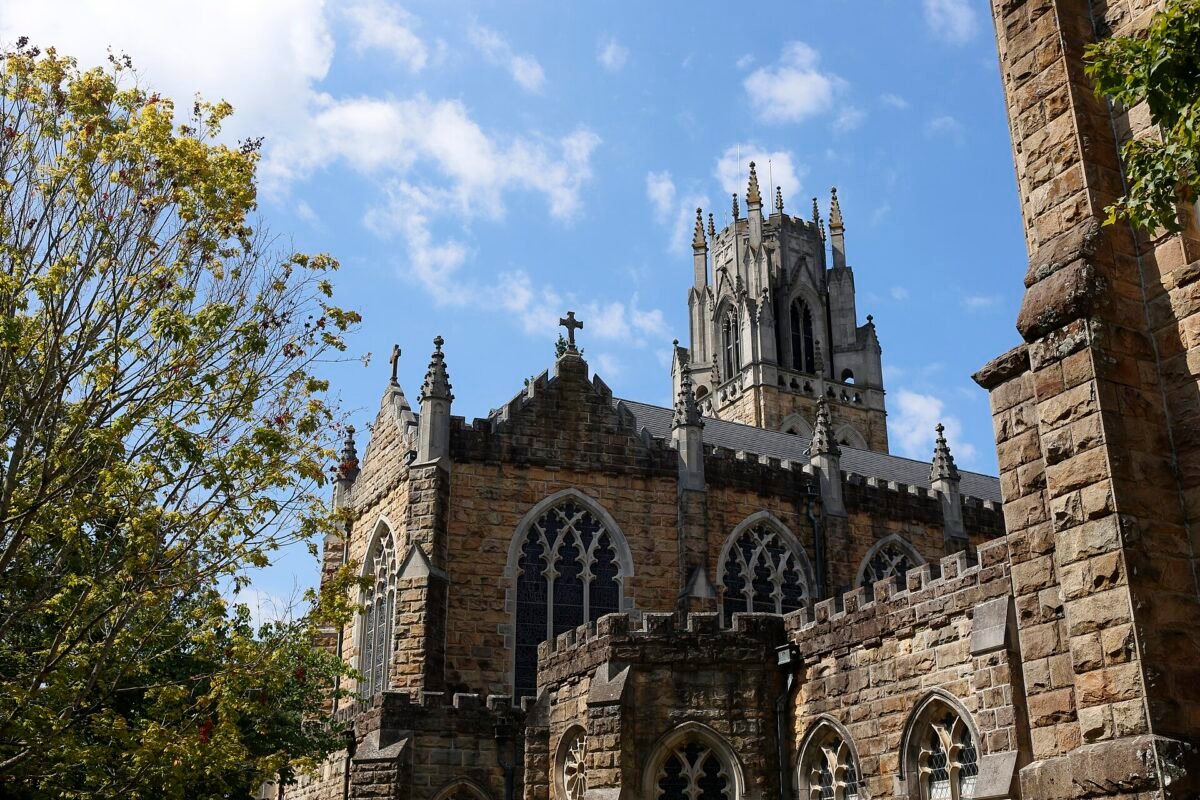
Sewanee’s story starts with the same bishops. In 1856, ten Episcopal dioceses agreed to create a single university for the South, and on July 4, 1857, delegates meeting on Lookout Mountain named its first trustees. Bishops Leonidas Polk, James Otey, and Stephen Elliott led the effort. Polk and Elliott secured from the Diocese of Louisiana alone what the Tennessee Encyclopedia calls “the largest sum ever pledged for an educational institution in America.” The site was a 10,000-acre tract on the plateau, with a nine-mile railroad already crossing it.
The cornerstone went down on October 10, 1860. Sewanee’s own research summary describes what stood behind the ceremony. The university, it says, was “designed from the start to represent, protect, and promote the South’s civilization of bondage.” Enslaved people did most of the hard labor to prepare the mountain for a campus, clearing the wooded plateau and building its early structures, homes, and roadways. All but four of the 37 original trustees owned enslaved people. Otey, Polk, and Elliott were slaveowners and later supporters of the Confederacy.
The war broke the plan. By 1866 the three founding bishops had died, the cornerstone had been destroyed, and the forest had taken back the clearing. That year, the bishop of Tennessee and the university’s commissioner of buildings and lands came back to re-establish the institution, with the money raised before the war gone and the South poor. Bishop Charles Quintard raised funds in England to help reopen it.
The University of the South held its first convocation on September 18, 1868. Nine students and four professors met in a clapboard chapel, and the campus was three simple frame buildings. The place that visitors know today as Sewanee grew out of that small beginning.
The railroad that climbed
Sewanee and Monteagle both depended on a way up. The Nashville and Chattanooga Railway reached this part of Tennessee in the 1850s and used a 2,200-foot tunnel at Cowan to get through the Cumberland Plateau. A branch line was then built from Cowan up the mountain. It was called the Mountain Goat, and it climbed about 800 feet in eight miles on a 2 percent grade. The line carried coal and passengers between Cowan, Sewanee, Monteagle, Tracy City, and Palmer.
The railroad shaped the resorts that came after it. The Tennessee Coal and Railroad Company gave land and money to the Monteagle assembly, and excursion trains later carried visitors from nearby cities. The tracks were pulled up in 1985. The old roadbed is now the Mountain Goat Bike Path.
A summer school for Sunday school teachers
Monteagle’s story began in 1882, when Tennessee Sunday school workers organized a summer assembly on the model of the Chautauqua assembly in New York, started in the 1870s to train Sunday school teachers during the summer. The town of Monteagle and the Tennessee Coal and Railroad Company offered the site. The railroad and the town’s founder, John Moffatt, each gave $5,000, and the railroad donated about 1,100 acres. The charter stated its purpose as “the advancement of Science, Literary Attainment, Sunday School interests.”
The first session opened on July 17, 1883. Few comforts existed that first summer, and the only permanent structures were a restaurant and an amphitheater. More than 1,000 people came anyway, staying in tents or at a hotel in town. By the next year, members had started building their own cottages on leased lots. The Assembly became the southern headquarters of the Chautauqua Literary and Scientific Circle, and it offered at least 19 schools of courses at one point.
The early members were mostly Baptists and Methodists, joined later by Episcopalians and Presbyterians. In the early twentieth century, guest orchestras played twice daily, and excursion trains brought visitors from Chattanooga, Huntsville, and Nashville. The first amphitheater was replaced in 1901. After a fire, the present auditorium went up in 1927, with 1,500 seats.
Attendance fell with World War I, the Depression, and World War II, and interest returned in the 1960s and 1970s. The 1982 centennial brought new participation. Since World War II the program has become more secular, with lectures, children’s activities, and a six-week season.
What is left to see
Each place keeps its history in a different form.
In Beersheba Springs, many of the historic district’s cottages are still owned by descendants of their postwar buyers, and the Tennessee Encyclopedia notes that the town has a museum, a library, and a post office. The Beersheba Springs Historical Society formed in 1980 and published an illustrated town history in 1983. The old hotel belongs to the Methodist church and serves as a retreat and conference center.
Monteagle’s Assembly grounds are a National Register historic district. They hold 161 cottages, most built before 1930, and the 1927 auditorium. The oldest surviving building is an 1884 gymnasium. The Assembly’s 2027 season is scheduled for June 6 to August 1. Anyone planning a visit should call the Assembly at 931-924-2286 for current rules on entering the grounds.
Sewanee’s story is told in the university’s own history pages, including its research summary on slavery and race. The Mountain Goat Bike Path follows the old railroad grade.
If you go
- Beersheba Springs: Grundy County. Many of the historic district’s cottages are private family homes.
- Monteagle Sunday School Assembly: off US 64, US 41, and TN 56 in Monteagle. 2027 season June 6 to August 1. Call 931-924-2286 before visiting.
- Sewanee: Franklin County, on the University of the South’s campus. Check the university’s website for public events before you go.
How we reported this
Built from the Tennessee Encyclopedia, the National Register of Historic Places, the University of the South’s own history pages and research, local historical societies, and the Assembly’s own publications. Corrections to editor@uppersouthjournal.com.
- Tennessee Encyclopedia: Beersheba Springs, Historic Resorts, Monteagle Sunday School Assembly, and University of the South
- Grundy County Historical Society: Beersheba Springs
- Beersheba Springs Assembly
- National Park Service: Monteagle Sunday School Assembly Historic District
- Monteagle Sunday School Assembly: history and Mountain Voices, August 17, 2026
- University of the South: history of the university, Roberson Project research summary, and Founded to Make Men
- Chattanooga Times Free Press, December 17, 2017: Rebirth of the Mountain Goat Line
- Tennessee History for Kids: Franklin County